
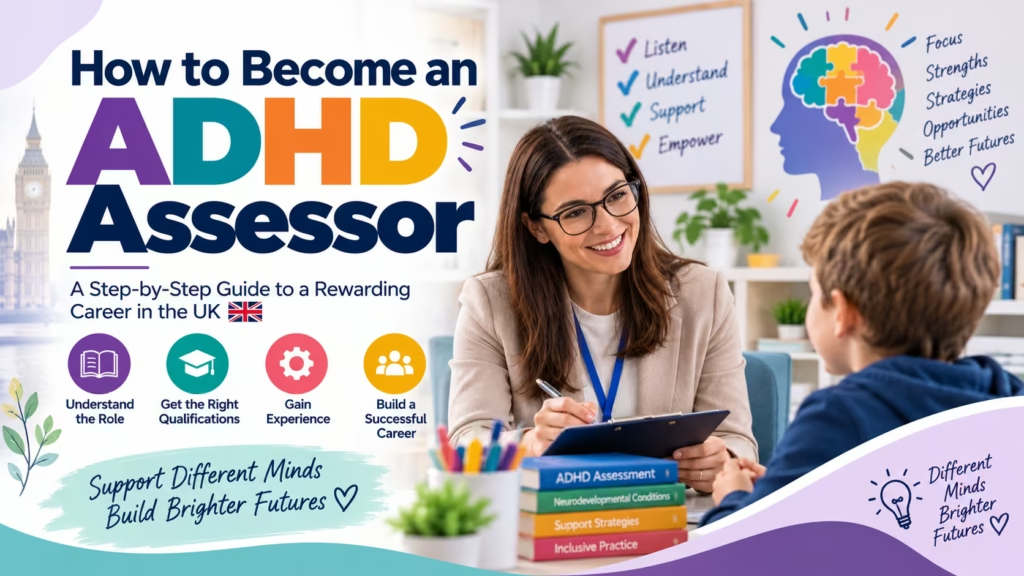
Quick answer
To become an ADHD assessor in the UK, you usually first qualify in a regulated healthcare or psychology profession, then complete specialist ADHD assessment training. Assessors carry out structured, evidence-based evaluations in line with NICE guidance and DSM-5 or ICD-11 criteria. Demand is growing because of rising awareness of adult ADHD and long NHS waiting times.
If you are wondering how to become an ADHD assessor, the most common route in the UK involves qualifying in a regulated healthcare or psychology profession and then undertaking specialist ADHD assessor training UK programmes. ADHD assessment professionals play a vital role in identifying attention deficit hyperactivity disorder and supporting individuals through evidence-based diagnosis and care pathways.
With growing awareness of neurodevelopmental disorders and increasing demand for adult and child assessments, ADHD assessor jobs and ADHD assessment jobs UK are expanding across the NHS and private healthcare sectors. Whether you are a nurse, psychologist, psychiatrist, occupational therapist, or another qualified healthcare professional, specialist ADHD diagnosis training UK and post-qualification development can help you become an ADHD assessment practitioner.
Quick Answer
To become an ADHD assessor in the UK, you usually need a professional qualification in healthcare or psychology, registration with an appropriate regulatory body, and specialist ADHD assessor training. Many professionals also complete ADHD assessment certification and additional ADHD specialist training to develop competence in conducting neurodevelopmental assessments and preparing ADHD assessment reports.
What Does an ADHD Assessor Do?
An ADHD assessor is a healthcare professional who conducts structured evaluations to determine whether an individual meets the diagnostic criteria for attention deficit hyperactivity disorder. These assessments are based on recognised frameworks, including DSM-5 criteria, ICD-11 guidelines, and NICE recommendations.
The role involves much more than simply identifying symptoms. ADHD clinicians gather information from clinical interviews, behavioural observations, medical histories, and screening and diagnostic tools to form evidence-based conclusions.
Typical responsibilities include:
- Conducting ADHD assessments for children and adults.
- Performing mental health assessments and psychiatric assessments.
- Using ADHD screening tools and structured questionnaires.
- Preparing comprehensive ADHD assessment reports.
- Collaborating with a multidisciplinary team.
- Providing recommendations for treatment and support services.
- Contributing to neurodevelopmental pathways and specialist clinics.
An independent ADHD assessor may work in NHS services, private practices, right to choose providers, or multidisciplinary assessment teams specialising in autism and ADHD assessments.
Why ADHD Assessment Professionals Are in High Demand in the UK
Demand for ADHD healthcare professionals has increased significantly in recent years. Greater awareness of neurodiversity, longer NHS waiting times, and improved understanding of adult ADHD have created a growing need for qualified assessors.
Several factors contribute to this demand:
First, more adults are seeking diagnosis after recognising lifelong symptoms affecting education, employment, and relationships. Adult ADHD psychiatry services have consequently experienced substantial increases in referrals.
Secondly, child and adolescent ADHD services and CAMHS services continue to receive growing numbers of referrals, requiring additional specialist practitioners.
Thirdly, the expansion of private assessment services and right to choose providers has created further opportunities for professionals interested in ADHD clinician jobs and autism and ADHD assessor jobs.
As a result, professionals with ADHD assessor qualifications and specialist training often enjoy strong career prospects across both public and private sectors.
Understanding Attention Deficit Hyperactivity Disorder and Neurodevelopmental Disorders
Attention deficit hyperactivity disorder is a neurodevelopmental disorder characterised by persistent difficulties with attention, impulsivity, and hyperactivity. These symptoms can affect academic performance, work, relationships, and everyday functioning.
ADHD exists alongside other developmental disorders and frequently overlaps with conditions such as:
- Autism spectrum disorder.
- Dyslexia.
- Dyspraxia.
- Anxiety disorders.
- Depression.
- Learning difficulties.
Modern healthcare increasingly adopts a neurodiversity-informed approach, recognising that neurological differences represent natural variations rather than deficits. This perspective has transformed how ADHD assessments are conducted and how support services are delivered.
Consequently, many ADHD specialist practitioners work closely with educational psychologists, clinical psychologists, psychiatrists, and psychiatric nurse practitioners to provide holistic care.
What Is an ADHD Assessment and How Does the Diagnostic Process Work?
An ADHD assessment is a structured and evidence-based process designed to determine whether an individual meets recognised diagnostic criteria. It involves gathering information from multiple sources and evaluating symptoms within the context of daily functioning.
Comprehensive assessments usually include:
Clinical interviews.
- Medical and developmental history.
- Behavioural observations.
- Standardised ADHD screening tools.
- Input from family members or teachers when appropriate.
- Differential diagnosis and mental health assessment.
- Preparation of an ADHD assessment report.
The process aims to provide accurate diagnoses while identifying co-existing conditions and support requirements.
Understanding the ADHD Assessment Framework UK
The ADHD assessment framework UK follows guidance established by NICE and professional bodies. Assessments are expected to be person-centred, evidence-based, and conducted by appropriately trained professionals.
The framework places emphasis on:
- Thorough clinical interviews.
- Functional impairment across different settings.
- Differential diagnosis.
- Identification of co-existing neurodevelopmental disorders.
- Collaborative multidisciplinary working.
The ultimate goal is to ensure individuals receive accurate diagnoses and appropriate interventions.
The ADHD Diagnostic Pathway in the UK
The ADHD diagnostic pathway generally begins when symptoms raise concerns in education, work, or daily life.
A typical ADHD assessment pathway UK includes:
| Stage | Description |
|---|---|
| Referral | Referral through GP, CAMHS, NHS services, or private providers |
| Initial Screening | Review of symptoms and medical history |
| Comprehensive Assessment | Clinical interviews and behavioural assessments |
| Diagnostic Evaluation | Application of DSM-5 criteria and ICD-11 guidelines |
| Report Preparation | Detailed ADHD assessment report |
| Recommendations | Medication, therapy, education, or workplace support |
In many regions, multidisciplinary assessment teams are involved to ensure comprehensive evaluations.
DSM-5 Criteria and ICD-11 Guidelines Explained
Two major classification systems guide ADHD diagnosis:
DSM-5 Criteria
The Diagnostic and Statistical Manual of Mental Disorders (DSM-5) outlines specific symptom clusters involving:
- Inattention.
- Hyperactivity.
- Impulsivity.
Symptoms must:
- Persist for at least six months.
- Be present in multiple settings.
- Cause significant impairment.
- Not be explained by another condition.
ICD-11 Guidelines
The International Classification of Diseases (ICD-11) also recognises ADHD as a neurodevelopmental condition. ICD-11 guidelines align closely with DSM-5 while providing additional international diagnostic standards.
Both frameworks are widely used by ADHD clinicians and neurodevelopmental specialists throughout the UK.
Evidence-Based Assessment and Clinical Decision-Making
Modern ADHD diagnosis relies on evidence-based assessment rather than assumptions or isolated observations.
Clinical decision-making incorporates several elements, including:
Medical history, behavioural patterns, developmental milestones, academic performance, occupational functioning, and emotional wellbeing. Healthcare professionals must carefully distinguish ADHD from other conditions that may present similarly.
Differential diagnosis is especially important because anxiety, trauma, depression, autism spectrum disorder, and sleep disorders can influence attention and behaviour.
Professionals undertaking ADHD diagnosis training UK programmes develop skills in integrating information from various sources to produce accurate and clinically meaningful conclusions.
Common ADHD Symptoms in Adults and Children
ADHD symptoms in adults and ADHD symptoms in children can vary considerably.
Children commonly experience:
- Difficulty concentrating.
- Excessive activity.
- Impulsiveness.
- Problems following instructions.
- Challenges in school environments.
Adults may present differently. Symptoms often include disorganisation, poor time management, forgetfulness, emotional dysregulation, and difficulties maintaining focus at work.
Hyperactivity may become less obvious with age, while inattentive symptoms frequently persist into adulthood.
Because symptom presentation changes over time, professionals conducting adult ADHD assessment and child assessments require specialised knowledge and training.
Recognising these variations is one reason why ADHD specialist training and post-qualification training are essential components of becoming a competent ADHD assessment practitioner.
Frequently Asked Questions: How to Become an ADHD Assessor
Most ADHD assessors first qualify in a regulated healthcare or psychology profession, then complete specialist ADHD assessment training.
An ADHD assessor carries out structured evaluations to decide whether a person meets the diagnostic criteria for ADHD, gathering information from multiple sources such as interviews, history and rating scales.
UK ADHD assessments follow NICE guidance and use recognised diagnostic criteria from DSM-5 and ICD-11.
Yes. Greater awareness of adult ADHD and neurodiversity, together with long NHS waiting times, has increased demand for trained ADHD assessment professionals.
Related career guides
- How to Become an Autism Assessor in the UK
- How to Become an ADHD Coach
- Top 15 Highest-Paying Social Work Careers in the UK