

Choosing a career is about more than finding a job that pays well. The strongest high-income careers usually combine specialised expertise, significant responsibility, scarce skills and strong demand. For someone researching the highest paying jobs in the world 2027, these factors matter just as much as the headline salary.
The list below combines established high-income professions with technology and finance careers that are becoming increasingly important. Salary figures are based on the latest available benchmarks, mainly 2025–2026 data, because reliable salary data for 2027–2028 does not yet exist for every occupation. Compensation can also change dramatically according to country, city, employer, seniority, performance, bonuses, equity and business ownership.
The goal is therefore not to claim that one profession is universally number one. Instead, this guide shows which careers have exceptional earning potential and what it takes to build one.
What Are the Highest-Paying Jobs in the World in 2027?
The world’s highest-paying careers include senior executive leadership, specialist medicine, investment banking, quantitative finance, AI and machine learning, corporate law, specialist dentistry, aviation, energy engineering and cybersecurity leadership. The greatest compensation is often found at senior levels, where professionals combine technical expertise with decision-making responsibility, commercial impact, scarce skills or ownership.
Salary Snapshot: 10 Highest-Paying Jobs at a Glance
Rank | Career | Indicative Salary/Compensation | Main Industry | Typical Education |
1 | CEO | $213,990 US median; top executives can earn far more | Business | Bachelor’s/Master’s |
2 | Specialist Surgeon | $275,930 physicians/surgeons median; specialist medians can exceed $400k | Healthcare | Medical degree + specialist training |
3 | Anaesthesiologist | $391,490 US median | Healthcare | Medical degree + specialist training |
4 | Investment Banker | £230k–£350k+ base for London MDs, plus bonus | Finance | Bachelor’s/Master’s |
5 | AI/ML Engineer | 182k–250k median listed range for US AI engineers | Technology | Bachelor’s/Master’s |
6 | Quantitative Analyst | About £90k average London base; senior compensation can be much higher | Finance/Technology | Bachelor’s/Master’s |
7 | Corporate Lawyer | $159,670 US median; top 10% above $351,600 | Legal | Law degree + qualification |
8 | Orthodontist | $289,140 US median | Healthcare | Dental degree + specialist training |
9 | Petroleum/Energy Engineer | $144,910 US median | Energy | Engineering degree |
10 | Cybersecurity/Technology Leader | $129,180 US median for information security analysts; leadership can pay more | Technology | Bachelor’s/Master’s |
These figures are indicative rather than forecasts. For example, US BLS data show that specialist medical occupations dominate its highest-paid occupation list, while technology and finance roles can have substantial upside through seniority, bonuses or equity.
Social Work Salary Comparison
Career | Indicative Salary/Rate | Typical Level |
Director of Social Services | £115k–£150k+ | Executive |
Head of Social Work | £100k–£130k+ | Executive |
Assistant Director | £90k–£130k | Senior Leadership |
Service Manager | £55k–£75k+ | Management |
Consultant Social Worker | £52k–£65k+ | Advanced |
Independent Reviewing Officer | £55k–£65k | Senior |
Practice Educator | £45k–£63k+ | Experienced |
Principal Social Worker | £47k–£65k+ | Senior |
AMHP | £45k–£60k+ | Specialist |
Senior Mental Health Social Worker | £49k–£60k+ | Senior |
Children’s Team Manager | £50k–£60k+ | Management |
Forensic Social Worker | £43k–£56k+ | Specialist |
Registered Care Manager | £50k–£65k+ | Management |
Hospital Social Worker | £38k–£45k+ | Experienced |
Agency/Locum Social Worker | £40–£45+/hour | Experienced |
Note: These figures are indicative rather than guaranteed 2027 salaries. Actual pay depends on employer, location, experience, responsibilities and employment conditions.
1. Chief Executive Officer (CEO)
A Chief Executive Officer carries responsibility for an organisation’s overall direction, performance and long-term strategy. CEOs make decisions involving investment, hiring, expansion, risk, products and company culture.
In the US, the BLS reported a 2025 median annual wage of $213,990 for chief executives, with the highest 10% earning more than $507,730. However, this does not represent the total compensation of major listed-company CEOs, where bonuses, stock awards and long-term incentives can dramatically increase earnings.
The usual route is not a single qualification. Many executives begin in finance, engineering, technology, sales or operations before progressing into management. An MBA can help, but leadership experience and commercial judgement are usually more important at senior levels.
This career suits people who enjoy decision-making, leadership, strategic thinking and responsibility. It is one of the highest paying careers, but reaching the top generally requires many years of experience.
2. Neurosurgeon / Specialist Surgeon
Specialist surgeons are among the most highly compensated professionals because their work combines extensive training, advanced technical ability and extremely high responsibility.
The US BLS reported a $275,930 median annual wage for physicians and surgeons in 2025. Within that broad category, the median was $414,010 for surgeons classified as “all other”, while paediatric surgeons reached $559,030.
Becoming a neurosurgeon or another specialist surgeon requires a long medical pathway. This normally includes undergraduate education, medical school, internship or residency and specialist training. Some systems also require additional fellowship training.
Private healthcare can create additional earning opportunities, while public-sector compensation is normally structured through national or regional pay systems.
The career is suited to people who can handle long training, intense concentration, high-pressure decisions and significant responsibility.
3. Anaesthesiologist / Anaesthetist
Anaesthesiologists play a critical role before, during and after surgery. They assess patients, administer anaesthesia, monitor vital signs and manage complications during procedures.
US BLS data put the 2025 median annual wage for anaesthesiologists at $391,490, placing the profession among the highest-paid occupations in its database.
Terminology varies internationally. “Anaesthesiologist” is common in the US, while “anaesthetist” can be used differently in countries such as the UK.
The pathway requires medical education followed by extensive specialist training and licensing. Strong knowledge of pharmacology, physiology, critical care and emergency decision-making is essential.
The profession can offer excellent earning potential, but the responsibility is substantial. Candidates should consider stress, on-call work, training length and lifestyle alongside salary.
4. Investment Banker / Senior Finance Executive
Investment banking remains one of the most attractive highest paying finance jobs for professionals who reach senior levels.
Investment bankers advise companies, governments and financial institutions on mergers and acquisitions, capital raising, restructuring and other major transactions. Senior professionals can earn substantial bonuses because their work can directly influence very large transactions.
A 2025–2026 UK financial-services salary guide lists London Tier One investment-banking Managing Directors at approximately £230,000–£350,000+ base salary, with bonuses potentially ranging from 0% to 120% of base.
That illustrates why base salary alone can be misleading when discussing an investment banker salary. Total compensation may include bonuses and other benefits.
The traditional route involves a strong academic background, internships and graduate recruitment into an investment bank. Progression typically moves from analyst to associate, vice president, director and managing director.
This path suits analytical, commercially minded people who can perform under pressure and tolerate demanding working hours.
5. AI / Machine Learning Engineer
AI engineering is one of the most important additions to discussions about the highest paying AI jobs.
AI and machine learning engineers build, train, evaluate and deploy systems that use machine learning. Their work increasingly includes generative AI, large language models, AI agents, automation, model evaluation, data pipelines and MLOps.
A current October 2026 analysis of 43,027 US job postings with salary information found a median listed range of 182,000–250,000 for AI engineer roles, while machine learning engineer postings showed a median range of 197,375–265,000.
The role normally requires strong programming, mathematics, statistics, machine learning and software engineering skills. Experience with cloud platforms, model deployment and data engineering can improve employability.
AI careers are particularly interesting because the World Economic Forum identifies AI and machine learning specialists among the fastest-growing roles through 2030.
For technology-focused students, this is one of the strongest future careers 2027 to investigate.
6. Quantitative Analyst / Quant
A quantitative analyst, or “quant”, applies mathematics, statistics and programming to financial problems.
Quants can work in investment banks, hedge funds, asset managers and proprietary trading firms. They develop models for pricing, portfolio construction, risk management and trading.
Current London salary data from Indeed show an average base salary of roughly £90,000 per year for quantitative analysts, while specialist compensation can rise substantially with experience and performance.
The skill requirements are demanding. A strong quant typically needs probability, statistics, calculus, linear algebra, programming and financial modelling. Python, C++ and other technical tools are commonly valuable.
The biggest earning opportunities tend to occur in highly competitive trading and investment environments where compensation can include significant performance-related pay.
Quant finance suits people who genuinely enjoy mathematics, coding, markets and solving complex problems.
7. Corporate Lawyer / Senior Legal Professional
Corporate lawyers help businesses manage transactions, contracts, regulatory requirements, disputes and major strategic decisions. High-end specialisations include mergers and acquisitions, financial regulation, international commercial law and private equity transactions.
The US BLS reported a 2025 median annual wage of $159,670 for lawyers, while the highest 10% earned more than $351,600.
Senior partners at major firms and general counsel at large companies can have significantly different compensation structures from ordinary salaried lawyers. Partnership profit-sharing and executive compensation can materially increase earnings.
Becoming a lawyer normally requires a formal legal education and professional qualification, although the exact route varies by country.
This career suits strong communicators who enjoy research, negotiation, writing and complex problem-solving.
8. Orthodontist / Specialist Dentist
Orthodontists specialise in correcting teeth and jaw alignment. Their work includes diagnosis, treatment planning and the use of braces, aligners and other orthodontic techniques.
The US BLS reported a 2025 median annual wage of $289,140 for orthodontists, compared with $170,950 for general dentists. Oral and maxillofacial surgeons had an even higher median of $352,220.
The career requires a dental degree followed by specialist training and professional licensing. In some countries, private practice creates additional earning potential because professionals may eventually own or operate a clinic.
The business side can therefore matter almost as much as clinical expertise. Location, patient demand, reputation, treatment mix and ownership structure can all influence income.
For people interested in healthcare but attracted to a combination of medicine, precision and entrepreneurship, specialist dentistry can be an appealing option.
9. Petroleum / Energy Engineer
Petroleum engineering remains a high-paying engineering career because extracting and processing hydrocarbons requires specialised technical knowledge and significant operational responsibility.
The US BLS reported a 2025 median annual wage of $144,910 for petroleum engineers, with the highest 10% earning more than $253,200. The oil and gas extraction industry had a median of $180,080.
The career typically requires a bachelor’s degree in petroleum engineering or a related discipline such as mechanical, civil or chemical engineering.
However, the energy industry is changing. Petroleum expertise increasingly intersects with areas such as carbon capture, geothermal systems and energy infrastructure.
At the same time, renewable energy engineers, environmental engineers and other professionals working on the energy transition are gaining importance. The World Economic Forum lists environmental and renewable-energy engineering roles among the fastest-growing roles through 2030.
10. Cybersecurity / Technology Leadership
As businesses become more dependent on cloud platforms, data and AI, protecting digital infrastructure becomes increasingly important.
Cybersecurity professionals protect networks, applications, identities, cloud environments and sensitive information. Senior roles can progress into security architecture, security engineering, cybersecurity management and technology leadership.
The US BLS reported a 2025 median annual wage of $129,180 for information security analysts, with the highest 10% earning more than $199,850.
Higher-level security architects and directors can earn more depending on organisation, location and responsibility.
Useful skills include network security, cloud security, identity and access management, incident response, risk management and security architecture. AI security and AI governance are also becoming relevant specialisations.
Cybersecurity is particularly attractive for people seeking a technology career with strong long-term demand.
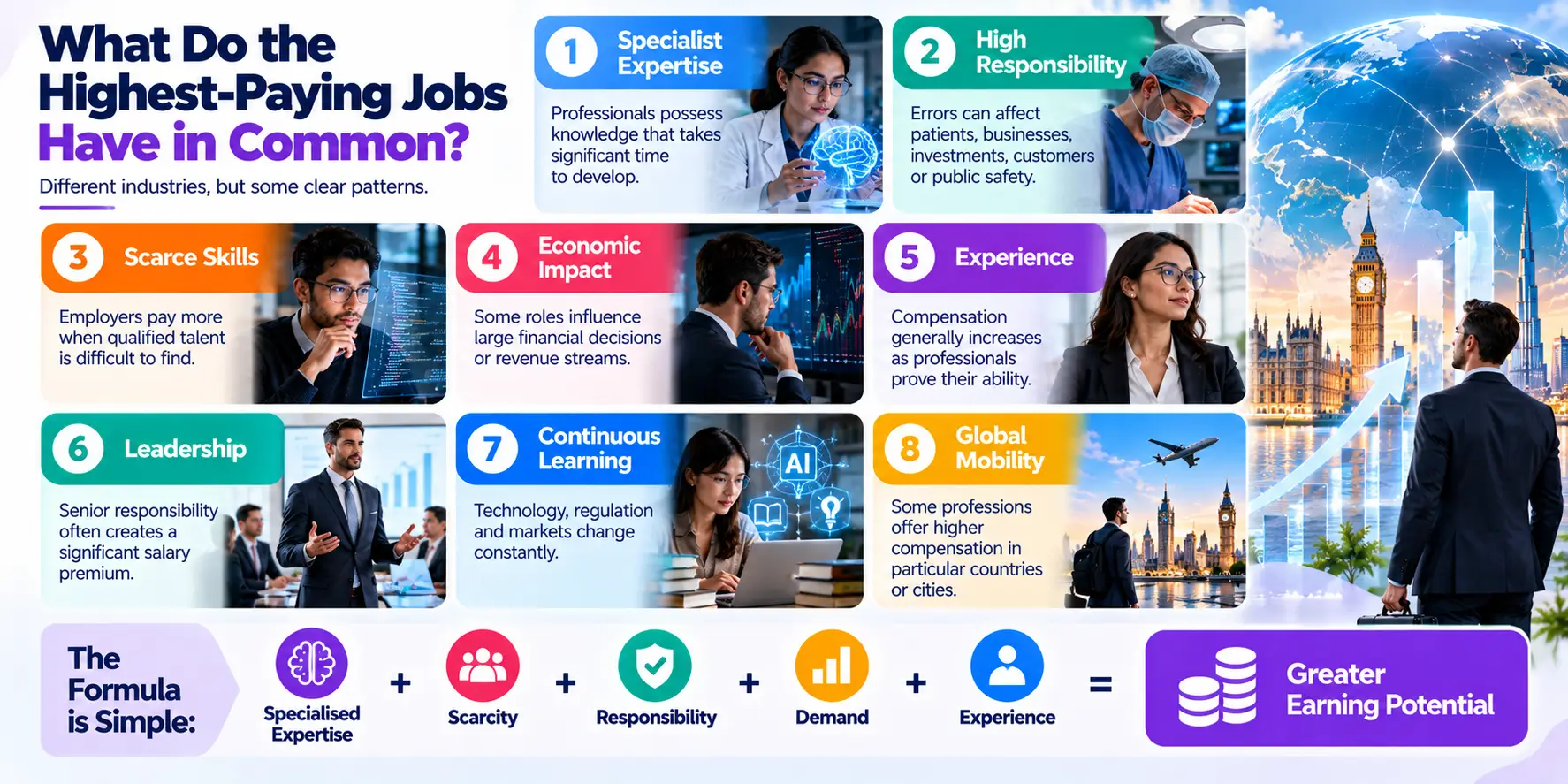
What Do the Highest-Paying Jobs Have in Common?
The highest paying jobs in the world are rarely easy-entry positions. Several patterns appear repeatedly:
- Specialist expertise: Professionals possess knowledge that takes significant time to develop.
- High responsibility: Errors can affect patients, businesses, investments, customers or public safety.
- Scarce skills: Employers pay more when qualified talent is difficult to find.
- Economic impact: Some roles influence large financial decisions or revenue streams.
- Experience: Compensation generally increases as professionals prove their ability.
- Leadership: Senior responsibility often creates a significant salary premium.
- Continuous learning: Technology, regulation and markets change constantly.
- Global mobility: Some professions offer higher compensation in particular countries or cities.
The formula is simple: specialised expertise + scarcity + responsibility + demand + experience = greater earning potential.
Fastest-Growing High-Paying Careers for the Future
The highest-paid career today is not necessarily the career with the strongest growth tomorrow.
The World Economic Forum’s Future of Jobs Report 2025 identifies Big Data Specialists, FinTech Engineers, AI and Machine Learning Specialists and Software and Application Developers among the fastest-growing roles through 2030. Environmental and renewable-energy engineering roles also appear strongly.
The report also identifies AI and big data, networks and cybersecurity, and technological literacy as the fastest-growing skill areas. Creative thinking, resilience, flexibility, curiosity and lifelong learning are also becoming more important.
This distinction matters. A rapidly growing occupation may not have the highest salary, while a highly paid profession may grow relatively slowly.
Trending Career Areas for 2027–2028
Several areas deserve attention when planning future jobs 2028:
- Generative AI and AI agents: Companies need professionals who can build, deploy and manage AI systems.
- Agentic AI and automation: AI systems capable of completing multi-step tasks are creating new engineering and product opportunities.
- Cybersecurity: Expanding digital infrastructure increases the need for security professionals.
- Cloud computing: Businesses continue to depend on scalable cloud infrastructure.
- Big data and data science: Organisations need professionals who can turn large datasets into useful decisions.
- FinTech: Financial services increasingly combine finance, software and data.
- Renewable energy: Energy transition creates demand for engineering and sustainability expertise.
- AI governance and AI security: Organisations need technical and policy expertise to manage AI responsibly.
These areas should not be treated as guaranteed high-income shortcuts. Their value comes from combining emerging demand with difficult-to-replace skills.
Highest-Paying Technology Jobs
Role | Core Skills | Why Demand May Grow |
AI Engineer | Python, ML, LLMs, MLOps | AI adoption |
Machine Learning Engineer | Statistics, ML, software | Intelligent applications |
Data Scientist | Statistics, Python, analytics | Data-driven decisions |
Cloud Architect | Cloud, networking, systems | Cloud infrastructure |
Cybersecurity Architect | Security, cloud, risk | Growing digital risk |
Software Engineer | Programming, architecture | Software and AI systems |
AI Product Manager | Product, AI, business | AI commercialisation |
The broader technology labour market also shows strong compensation. BLS data put software developers at a 2025 median of $135,980 and information security analysts at $129,180.
What About the Highest-Paying Jobs Without a Degree?
Not every high-income career requires a traditional university degree, but the opportunities are more limited than social media often suggests.
Technology, sales, entrepreneurship, skilled trades and some technical occupations can offer skills-based routes. Certifications, apprenticeships, professional training, portfolios, demonstrable experience and networking can help candidates compete without a conventional degree.
For example, skilled technical careers can be entered through alternative training routes. Upskillora’s guide to becoming an electrician without an apprenticeship explains how recognised qualifications and practical experience can provide an alternative route into the trade.
However, regulated professions such as medicine, dentistry and law normally require formal education and professional licensing. There is no legitimate shortcut around those requirements.
How to Prepare for a High-Paying Career in 2027–2028
Start with the career rather than the salary.
Step 1: Identify a high-value career. Compare earning potential with your interests and strengths.
Step 2: Research entry requirements. Check degrees, licences, certifications and experience requirements in your target country.
Step 3: Identify valuable skills. Look for skills employers repeatedly request.
Step 4: Choose appropriate education or training. A university degree is essential for some careers, while others value certifications or practical training.
Step 5: Build practical experience. Internships, placements, projects and entry-level employment make theoretical knowledge useful.
Step 6: Develop digital and AI skills. AI literacy is becoming relevant across industries, not only for programmers.
Step 7: Build a portfolio where appropriate. Technology, design, marketing and creative careers benefit particularly from demonstrable work.
Step 8: Strengthen communication and leadership. Technical ability alone does not guarantee progression.
Step 9: Build professional connections. Mentors, professional communities and industry contacts can reveal opportunities that job boards miss.
Step 10: Keep upskilling. The World Economic Forum estimates that 59 out of every 100 workers may need training by 2030.
The most useful future-proof skills are therefore a combination of technical capability, analytical thinking, communication, adaptability and AI literacy.

Are High-Paying Jobs Always the Best Careers?
Not necessarily.
A high salary can come with long training, stressful decisions, demanding schedules or significant financial and professional pressure. Investment banking can involve intense working hours. Medicine can require more than a decade of training. Executive positions involve substantial accountability.
Before choosing among the highest paying careers, consider:
- Job satisfaction
- Work-life balance
- Training time
- Stress level
- Job security
- Location
- Career progression
- Personal interests
- Existing skills
- Long-term demand
A career earning slightly less may ultimately be a better decision if it matches your abilities, lifestyle and long-term goals.
Salary Disclaimer
Salary figures are indicative and can vary significantly depending on country, location, employer, industry, experience, seniority, performance, bonuses, equity and other forms of compensation. Readers should check current local salary data and job vacancies before making career decisions.
Conclusion
The highest paying jobs in the world 2027 are likely to remain concentrated in professions where expertise is scarce, responsibility is high and the work creates significant value. Specialist medicine, executive leadership, finance, AI, quantitative finance, law, dentistry, aviation, energy and cybersecurity all offer strong earning potential, although the route into each career is very different.
For people planning their future careers 2027, the most important lesson is not simply to chase the largest salary. Build expertise that employers need, develop experience, learn continuously and understand how technology is changing your industry.
AI, cybersecurity, data, cloud computing, healthcare and renewable energy are particularly important areas to watch. Start with the career that fits you, then build the skills that can make you valuable within it.
Explore more practical career guides and learning resources on Upskillora to turn your career plans into a realistic development path.
FAQ
The highest-paying careers include specialist doctors and surgeons, CEOs, senior investment bankers, AI and machine learning engineers, quantitative professionals, corporate lawyers, specialist dentists and senior technology professionals. There is no universally confirmed number-one job because compensation varies by country, employer, seniority, bonuses, equity and private practice.
There is no single globally highest-paying career. Specialist medical professionals can earn extremely high salaries, while CEOs, investment bankers and senior finance professionals may receive much larger total compensation packages through bonuses, profit-sharing or equity. The highest possible income therefore depends heavily on the specific role and compensation structure.
AI engineers, machine learning engineers, specialised software engineers, cloud architects, cybersecurity specialists and senior technology leaders can command strong compensation. AI roles can be particularly attractive because businesses are investing heavily in machine learning, generative AI and automation. Actual earnings depend on technical depth, experience, location and employer.
Yes. AI and machine learning are among the strongest technology career areas for earning potential and future demand. The World Economic Forum lists AI and machine learning specialists among the fastest-growing roles through 2030. Senior professionals may also receive bonuses or equity in addition to base salary.
AI and machine learning specialists, big data specialists, FinTech engineers and software developers are among the fastest-growing roles identified by the World Economic Forum. Renewable energy and environmental engineering roles are also benefiting from the green transition. Growth potential, however, is different from guaranteed high pay.
Some technology, sales, entrepreneurship and skilled-trade careers can provide strong income without a traditional university degree. Certifications, apprenticeships, professional training, portfolios and experience can help. However, medicine, dentistry, law and other regulated professions generally require formal education and licensing, so they cannot simply be entered through short courses.
AI literacy, programming, data analysis, cybersecurity, cloud computing and advanced technical knowledge are valuable areas to develop. Human skills also matter. The World Economic Forum highlights analytical thinking, creative thinking, resilience, flexibility, leadership and lifelong learning alongside technology skills.
Choose a career that matches your strengths, research its entry requirements, gain the appropriate education or certification, build practical experience and develop skills employers value. Create a portfolio where relevant, network with professionals and continue upskilling. The strongest career strategy combines technical expertise with communication, adaptability and continuous learning.