
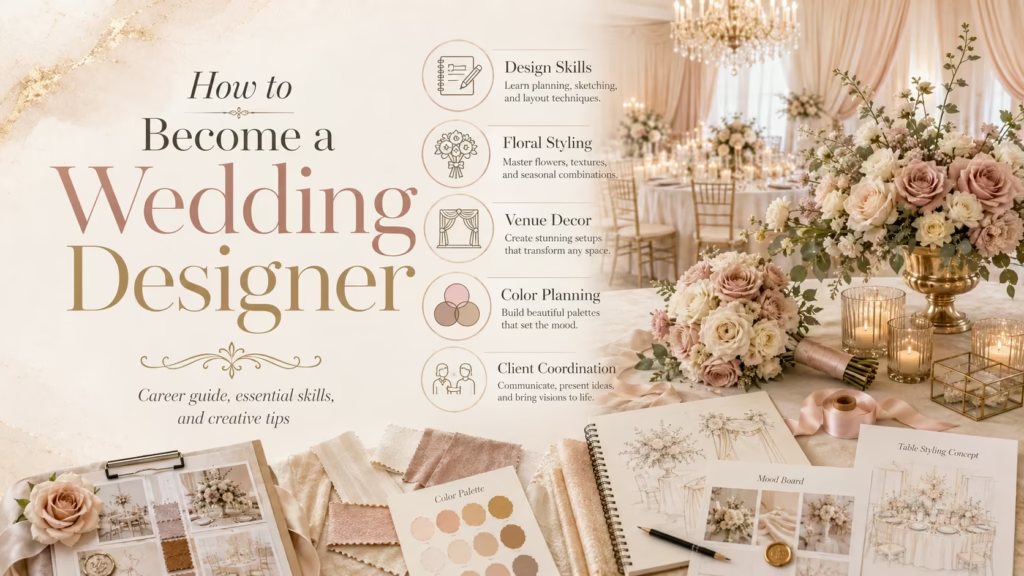
Essential Wedding Designer Qualifications and Industry Terminology
When researching how to get into wedding design, you will find there is no single mandatory university degree required. However, having specific wedding designer qualifications will immediately build your credibility with venue managers and premium clients. You must become completely fluent in industry terminology, learning how to speak confidently about architectural features, lighting design, and staging.
Key skills you need to build early in your wedding industry career include:
- Scale Drawing: Reading and creating scaled room diagrams.
- Bespoke Fabric Procurement: Understanding textile weights and fire-retardant ratings.
- Lighting Manipulation: Knowing how up-lighting, pin-spots, and ambient washes interact with decor.
Mastering the Craft: Color Theory for Weddings and Tablescape Design
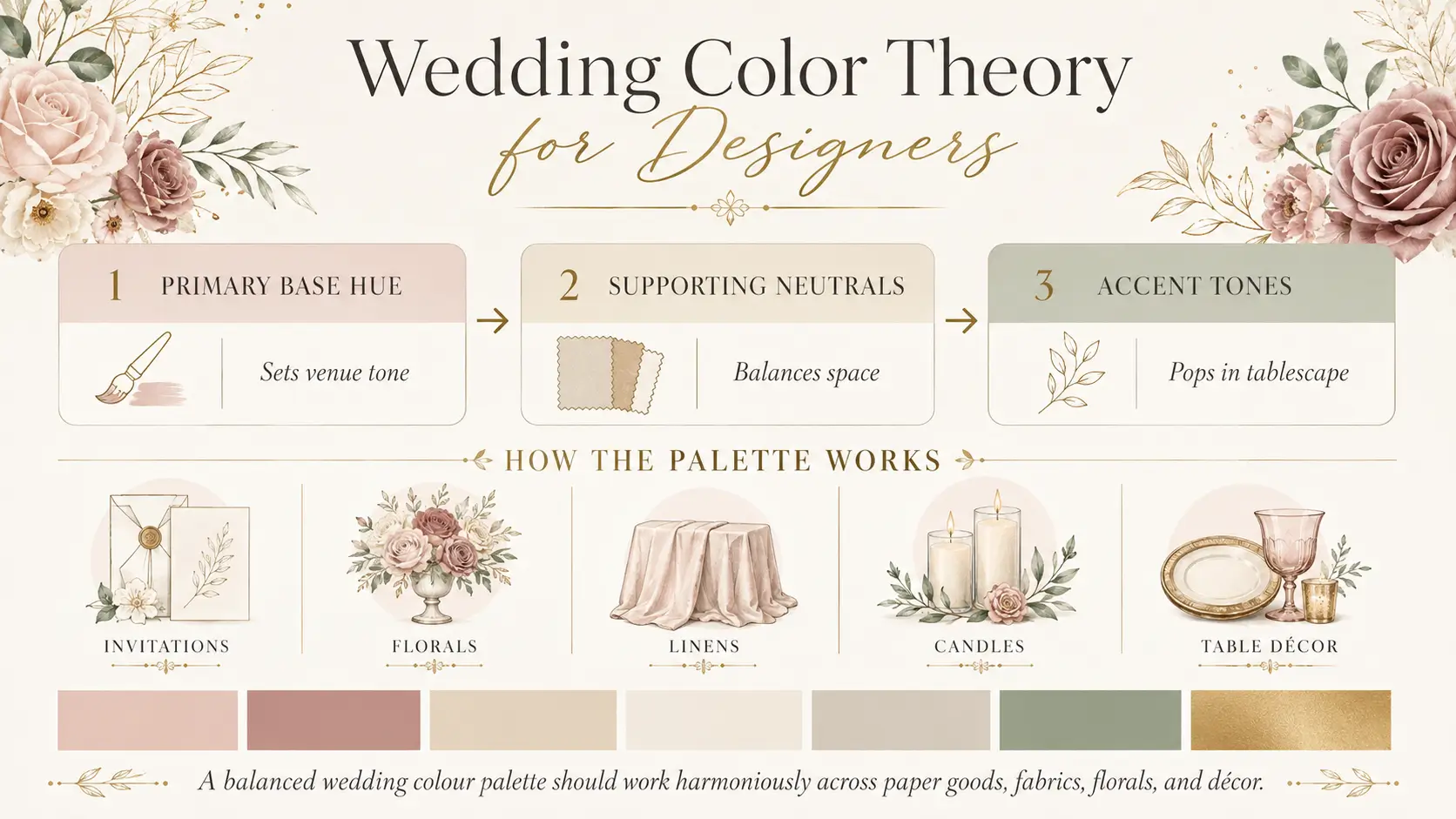
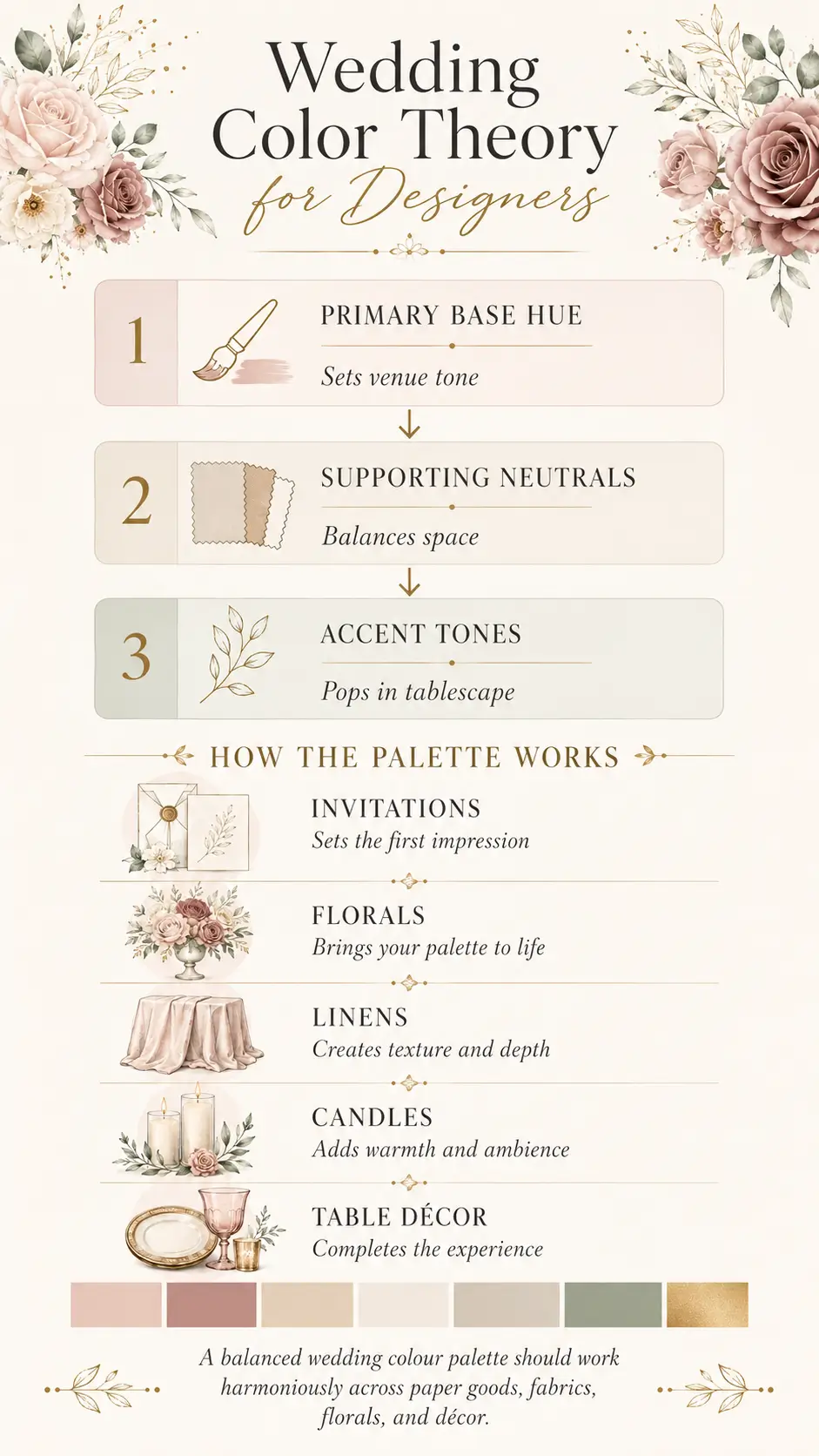
To stand out in the market, a designer must have a flawless grasp of color theory for weddings. You must understand how to construct a balanced wedding colour palette that works harmoniously across varying mediums—from paper invitations to heavy velvet table linens.
[Primary Base Hue] ───> [Supporting Neutrals] ───> [Accent Tones]
(Sets venue tone) (Balances space) (Pops in tablescape)
This training directly feeds into tablescape design, which is the detailed curation of everything placed on a reception table. This includes selecting the perfect chargers, custom glassware, specialized cutlery, and menu cards. A luxury tablescape relies on layer, height variation, and tactile contrast to create an unforgettable dining environment for guests during the reception styling.
Expanding Your Skillset with Floral Design Courses and Prop Sourcing
Top-Rated Wedding Styling Courses Online and Event Designer Certification
The fastest way to accelerate your education is to enroll in targeted wedding decorator training courses. If you need flexibility while balancing a current job, look for reputable wedding styling courses online that offer modules on spatial layouts, fabrics, and business operations.
Earning an accredited event designer certification provides immediate professional validation. These structured programs teach you how to write up creative briefs, manage sudden budget changes, and construct technical production files for on-site crew leads.
Why You Should Become a Certified Wedding Planner and Designer
While design is your true passion, choosing to become a certified wedding planner and designer makes you infinitely more employable. Many boutique agencies look for candidates who can seamlessly handle both sides of the coin.
Understanding the fundamentals of planning helps you design more effectively. For instance, if you understand catering logistics, you won’t design a tablescape that leaves no room for the serving platters. Dual certification ensures your concepts are always completely functional.
Portfolio Development: Showcasing Your Event Styling and Design Skills
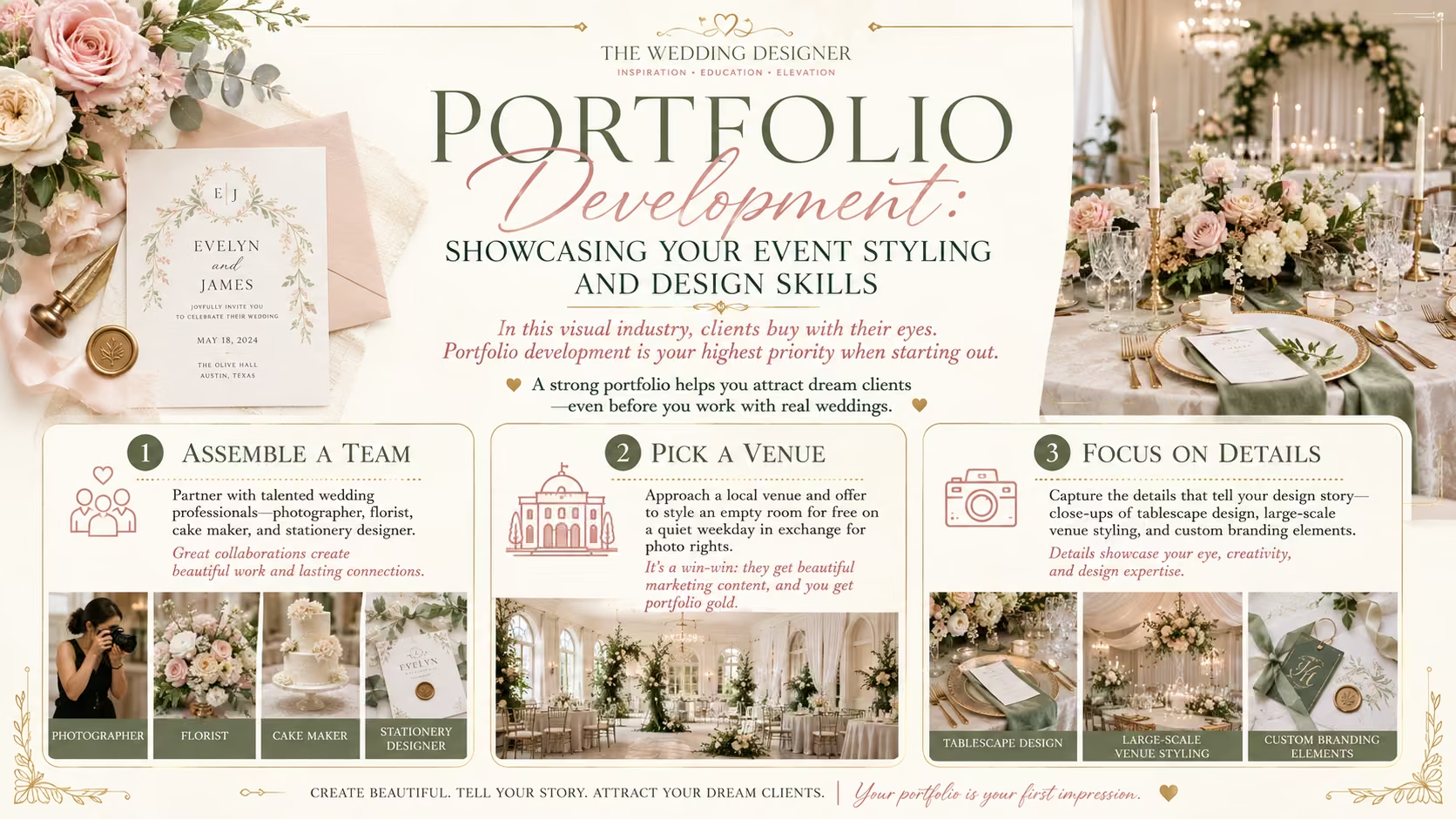
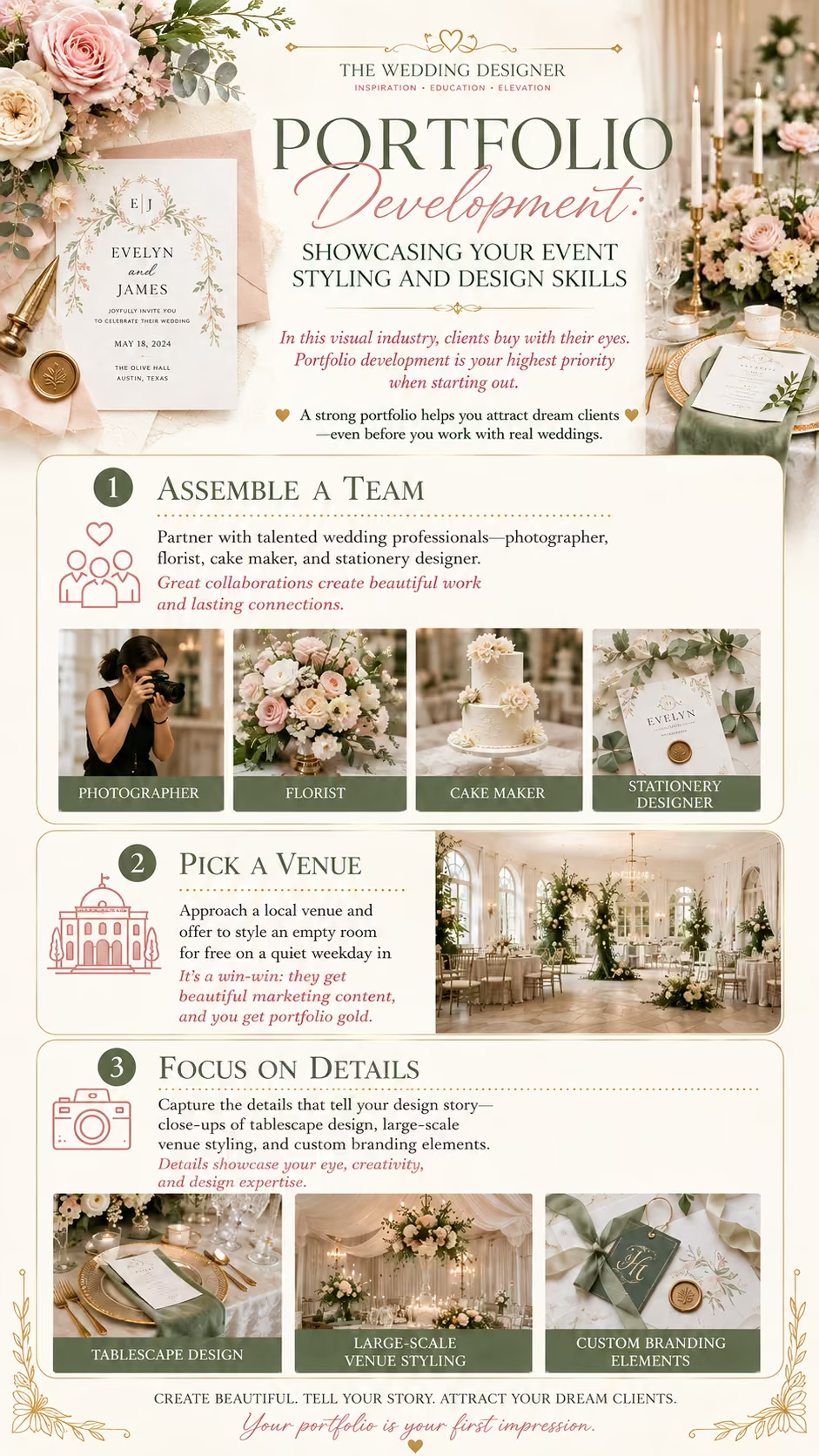
In this visual industry, clients buy with their eyes. Your absolute highest priority when starting out is portfolio development. If you don’t have real clients yet, you can build a stunning wedding design portfolio by organizing or participating in collaborative styled shoots.
- Assemble a Team: Partner with a rising local wedding photographer, a florist, a cake maker, and a stationery designer.
- Pick a Venue: Approach a local venue and offer to style an empty room for free on a quiet weekday in exchange for photo rights.
- Focus on Details: Capture close-ups of the tablescape design, large-scale venue styling, and any custom branding elements you created.
How to Start a Wedding Design Business: A Practical Start-Up Guide
The Client Consultation Process and Setting Up Vendor Collaboration
If your goal is to become a wedding decor entrepreneur, you need a clear blueprint. This wedding decoration business start up guide begins with mastering the client consultation skills required to close deals. Your initial meeting should focus on extracting the couple’s personal story, lifestyle preferences, and boundaries regarding their total investment.
1. Initial Discovery Session ──> 2. Concept & Mood Board ──> 3. Visual Proposal & Budget Approval
Once a client books your services, you must initiate vendor collaboration. You will work closely with florists, lighting technicians, prop manufacturers, and cake designers. Smooth communication ensures that every single creative professional is working off the exact same color swatches and style parameters.
Navigating Event Production and Logistics for Wedding Venue Decoration
The grandest design concept is completely useless if it cannot be physically brought into the building. Navigating event production and logistics is the unsung backbone of successful wedding venue decoration.
Before setup day, you must secure the venue’s load-in schedules, elevator dimensions, and strict out-of-hours packing restrictions. You need to prepare comprehensive production schedules detailing exactly when your team arrives, how long the fabric draping will take, and when the floral installations must be completed before guests arrive.
Marketing Your Services and Wedding Industry Networking
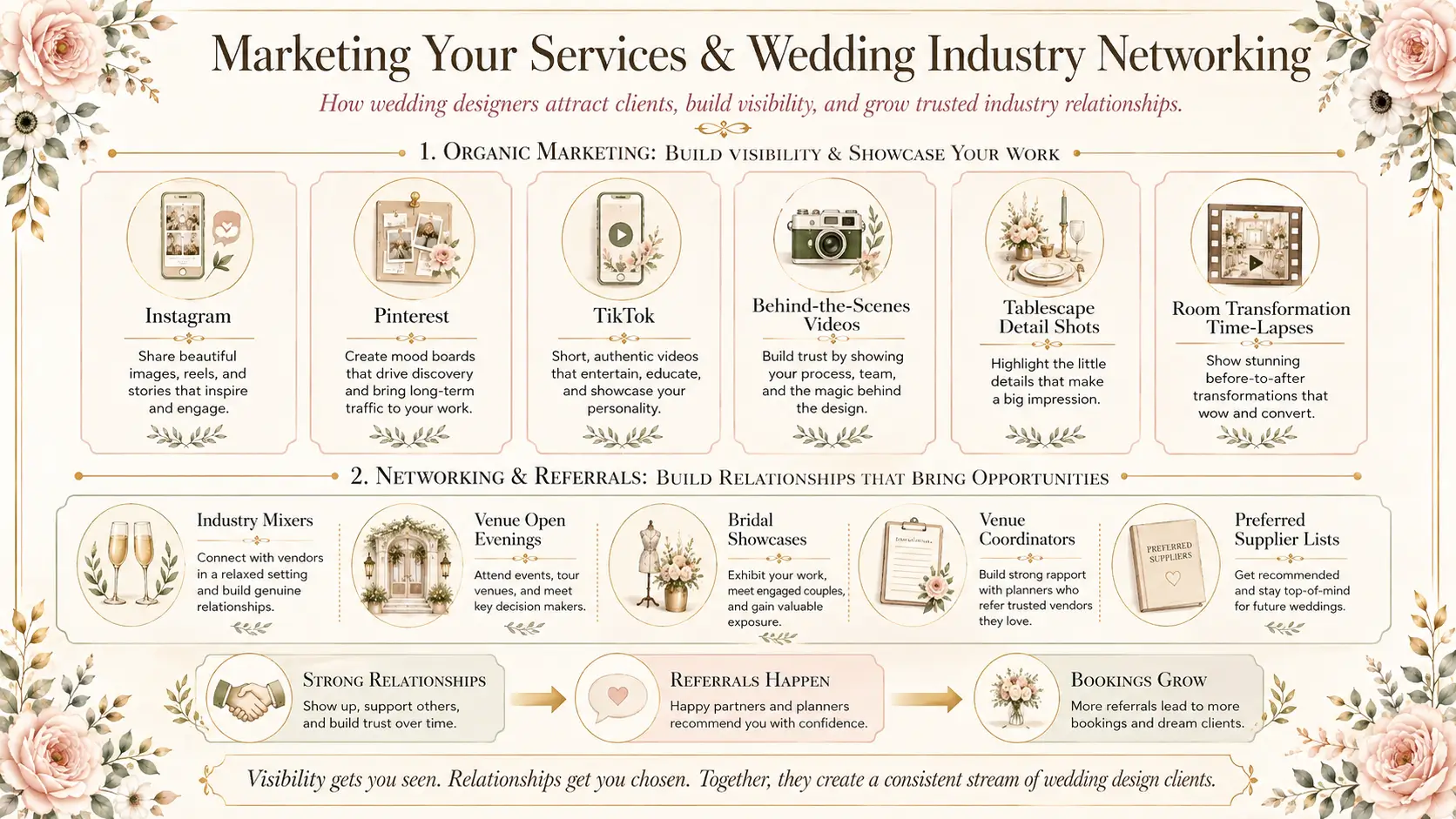
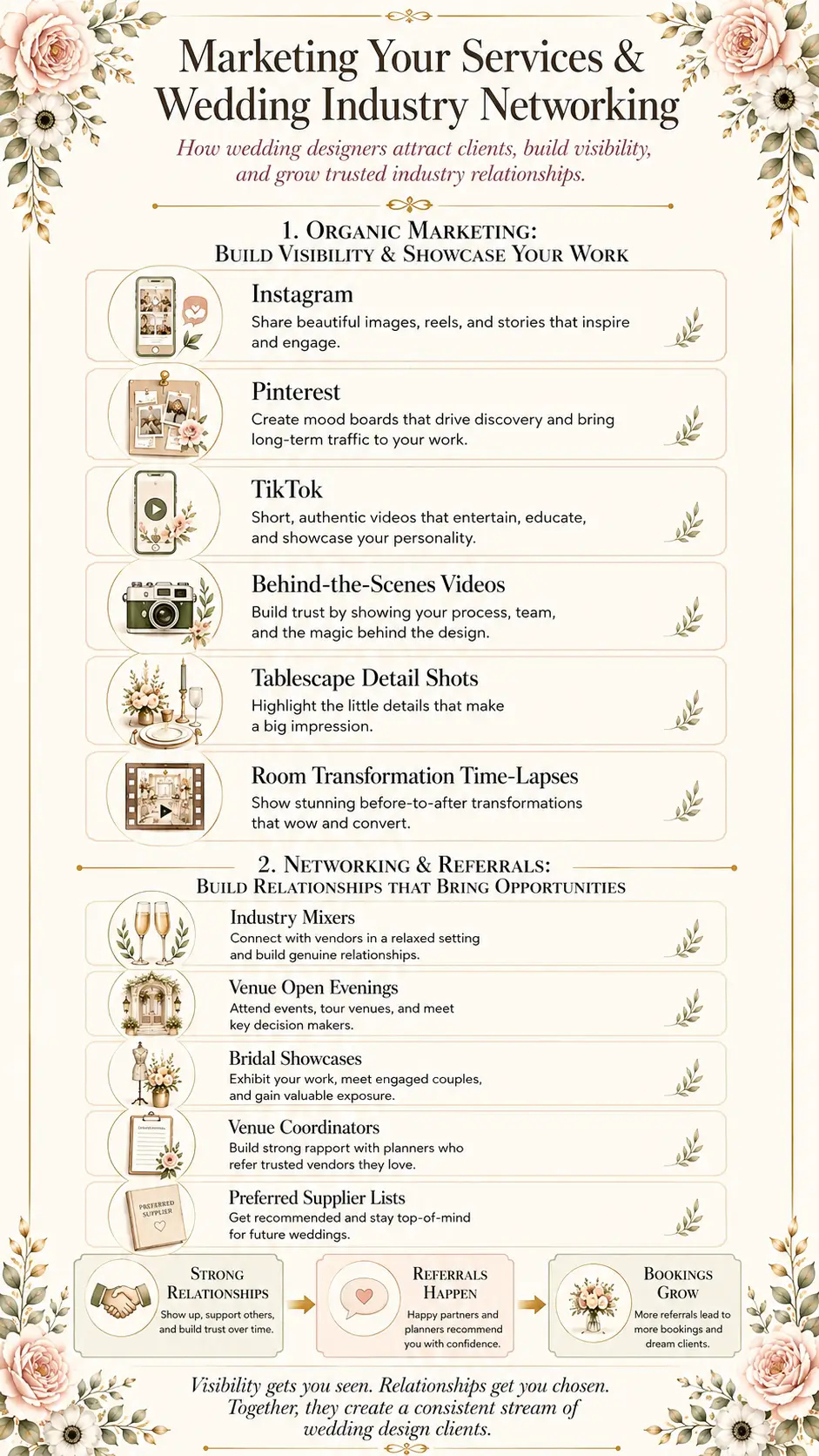
To consistently book clients for your event styling business, you must invest heavily in organic marketing. Since wedding design is visual, platforms like Instagram, Pinterest, and TikTok are your digital storefronts. Share behind-the-scenes videos of your setups, detail shots of tablescapes, and time-lapses of room transformations.
Equally important is active wedding industry networking. Attend local industry mixers, open evenings at venues, and national bridal wedding showcases. Building deep relationships with venue coordinators is incredibly lucrative, as they are the individuals who frequently pass preferred supplier lists directly to newly engaged couples.
Breaking Into the High-End Market: How to Become a Luxury Wedding Designer
The Nuances of Luxury Event Planning and High-End Prop Rentals
Transitioning from mid-tier weddings to the high-end market requires a profound shift in mindset. Learning how to become a luxury wedding designer means understanding that ultra-high-net-worth clients expect completely bespoke wedding experiences and impeccable discretion.
Luxury event planning leaves absolutely zero room for generic, mass-produced items. You will rarely use standard inventory; instead, you will frequently collaborate with high-end prop rentals firms or commission custom-built fabrication pieces—such as bespoke bars, hand-painted backdrops, and custom-designed dance floors that match the wedding branding and styling.
Attracting Premium Clients and Designing High-Budget Tablescapes
To attract luxury clients, your own branding must mirror the premium experience you claim to provide. Your website, stationary, and communication touchpoints must feel highly sophisticated.
When executing high-budget tablescapes, focus on hyper-customisation. This involves specifying heavy-weight silks, rare imported floral varieties, custom engraved monogrammed glassware, and artistic ambient lighting designed specifically for that single evening. The goal is to create an entirely transformative environment that feels completely exclusive.=
Industry Outlook: Wedding Designer Salary UK and Career Opportunities
Average Income of a Wedding Decorator and Freelance Rates
Your earning potential as a wedding decor specialist varies widely based on whether you choose employment or entrepreneurship. The wedding designer salary uk for an in-house designer at an established event production company typically starts between £22,000 and £26,000 per year. Experienced senior designers can command salaries ranging from £35,000 to £45,000+.
If you run your own freelance business or studio, your income is tied directly to your pricing model and booking volume. Most independent decorators work on a flat design fee or take a 10% to 15% production fee based on the overall decor budget. Successful luxury designers who limit themselves to 8–10 high-end events per year can easily generate net revenues far exceeding £60,000 annually.
Finding Entry-Level Opportunities: Wedding Decorator Jobs Near Me
If you want to gain hands-on experience before launching your own brand, look for entry-level wedding decorator jobs near me. Look beyond standard job boards and approach local marquee companies, floral design studios, and venue styling companies directly.
Offer your services as freelance assistant crew for weekend installations. This grit-and-glory work is where you truly learn how to handle sudden emergencies, how to work under tight setup windows, and how the industry operates in real-time.
Launching Your Dream Career in Wedding Styling and Design
Mastering how to become a wedding designer requires a dedicated blend of artistic passion, technical spatial execution, and active relationship building. By following a structured career path, focusing on high-quality portfolio development, and staying ahead of modern wedding trends, you can easily establish a highly respected name in the UK wedding industry. The demand for bespoke, visually breathtaking celebrations is higher than ever. Take that definitive first step today by exploring professional training courses, and transform your natural eye for beauty into a thriving, lifelong creative career.
FAQ - how to become a wedding designer
There are no formal university degree requirements to work as a wedding designer. However, completing a certified training course in event design, interior styling, or floral art is highly recommended. Gaining practical qualifications in spatial planning software and venue health and safety will significantly boost your credibility when working with high-end venues.
An entry-level in-house designer typically earns around £22,000 to £25,000 per year. Experienced professionals or successful business owners charging premium design fees can earn anywhere from £40,000 to over £60,000 annually, depending heavily on their location, target market, and seasonal booking volume.
Yes, you can absolutely become a wedding designer without a traditional university degree. The wedding industry values a strong, tangible visual portfolio, hands-on event experience, and trusted industry connections far above formal academic credentials. Focused, short-term industry certifications are often preferred by employers.
A wedding planner handles the logistical management of the entire event, including budgets, timelines, vendor contracts, and day-of coordination. A wedding decorator or designer focuses purely on the visual aesthetic, spatial planning, color palettes, floral concepts, and overall ambient transformation of the venue spaces.
Most private online or fast-track certification courses take between 3 to 6 months to complete. The duration depends on whether you study full-time or choose a part-time self-paced schedule while managing other professional commitments.
Yes, it can be highly profitable due to low initial overhead costs if you rent props rather than purchasing inventory upfront. Profitability increases rapidly as you build a strong brand reputation, allowing you to charge premium creative design fees while serving the higher-budget luxury market.