

Social work is a rewarding profession that offers opportunities to support children, families and adults while building a stable career. From mental health and safeguarding to hospitals, criminal justice and social care management, there are many paths available to qualified social workers.
If you are researching the highest paying social work careers UK, it is important to know that salaries vary considerably depending on experience, specialisation, location, employer and level of responsibility. Entry-level social workers generally earn less than experienced practitioners, while senior managers, directors and specialist professionals can progress into significantly higher-paid roles.
The National Careers Service currently lists around £32,000 for starting social workers and up to approximately £48,000 for experienced professionals. Senior and specialist positions can offer considerably more. (nationalcareers.service.gov.uk)
This guide explores 15 of the highest paying social work jobs UK, including indicative salaries, responsibilities, skills and potential career progression.
Social Worker Salary UK: What Determines Your Pay?
There is no single social worker salary UK figure. Your earnings can depend on several factors:
- Experience: More experience can lead to senior, specialist and management positions.
- Specialisation: Mental health, safeguarding and forensic work may provide specialist progression opportunities.
- Employer: Local authorities, NHS trusts, charities and private organisations use different salary structures.
- Location: Salaries and additional allowances can vary by region.
- Qualifications: Relevant postgraduate training and professional development can support progression.
- Management responsibility: Managing teams, budgets and services generally increases responsibility and pay.
- Employment type: Agency and locum positions can offer higher hourly rates, although benefits and job security may differ.
NHS positions can follow the Agenda for Change pay structure, providing a clear framework for progression in relevant roles.
Top 15 Highest-Paying Social Work Careers in the UK
1. Director of Adult or Children’s Social Services
Indicative salary: £115,000–£150,000+
Director-level social care positions are among the highest-paid career options available to experienced social work professionals.
Directors provide strategic leadership for large adult or children’s social care services. Their responsibilities can include safeguarding, service quality, budgets, workforce planning and partnership working with health and other public services.
Key skills:
- Strategic leadership
- Financial management
- Safeguarding
- Governance
- Strategic decision-making
Career route: Social Worker → Senior Social Worker → Team Manager → Service Manager → Head of Service → Assistant Director → Director
These roles require extensive experience and strong leadership ability. Salary varies significantly between councils and regions.
2. Head of Social Work / Chief Social Work Officer
Indicative salary: £100,000–£130,000+
A Head of Social Work provides professional leadership across a large organisation or social care service. The position may involve overseeing professional standards, workforce development, safeguarding and service improvement.
Chief Social Work Officer roles have particular statutory responsibilities in Scotland.
Key skills:
- Professional leadership
- Strategic planning
- Quality assurance
- Risk management
- Workforce development
This is generally a long-term career goal requiring substantial experience in senior social work and management.
3. Assistant Director of Adult or Children’s Social Care
Indicative salary: £90,000–£130,000
Assistant Directors manage major areas of social care and work closely with directors and other senior stakeholders.
Depending on the organisation, they may lead adult social care, children’s services, safeguarding, commissioning or service improvement.
Key responsibilities include:
- Strategic service management
- Budget management
- Staff leadership
- Performance improvement
- Partnership working
Strong experience in social care management is usually required. Developing leadership, financial and strategic skills can help social workers progress towards this level.
4. Social Work Service Manager
Indicative salary: £55,000–£75,000+
Service managers oversee teams or specialist social care services. They combine professional social work knowledge with operational management.
Their work may involve supervising managers, monitoring performance, managing resources and ensuring services meet required standards.
Useful skills include:
- Team leadership
- Supervision
- Performance management
- Problem-solving
- Safeguarding
A typical route is to gain frontline experience, become a senior practitioner or team manager and then progress into service management.
5. Consultant Social Worker
Indicative salary: £52,000–£65,000+
Consultant social workers are highly experienced practitioners who provide advanced professional knowledge without necessarily moving completely away from practice.
They may advise colleagues on complex cases, support professional development and contribute to improvements in social work practice.
Key skills:
- Advanced assessment
- Critical thinking
- Mentoring
- Professional judgement
- Evidence-based practice
This can be an attractive option for professionals who want career progression while remaining closely connected to social work practice.
6. Independent Reviewing Officer
Indicative salary: £55,000–£65,000
Independent Reviewing Officers, commonly called IROs, work primarily with looked-after children. They review care plans and provide independent challenge to ensure children’s needs and rights remain central to decision-making.
Responsibilities include:
- Reviewing care plans
- Monitoring progress
- Challenging professional decisions
- Promoting children’s welfare
- Supporting effective safeguarding
Experienced children’s social workers can move into IRO positions after developing strong knowledge of safeguarding and looked-after children’s services.
7. Practice Educator
Indicative salary: £45,000–£63,000+
Practice educators play an important role in preparing the next generation of social workers. They supervise and assess students during professional placements.
Key responsibilities:
- Student supervision
- Placement assessment
- Professional mentoring
- Reflective practice
- Supporting learning
This pathway can suit experienced social workers who enjoy teaching, mentoring and developing other professionals.
Additional practice education training and relevant experience can strengthen your profile.
8. Principal Social Worker
Indicative salary: £47,000–£65,000+
Principal Social Workers provide professional leadership and help improve social work standards across an organisation.
They may contribute to workforce development, practice improvement, quality assurance and professional guidance.
Key skills:
- Leadership
- Practice development
- Mentoring
- Quality improvement
- Communication
The role can provide an alternative to traditional management progression because it focuses strongly on professional leadership and practice quality.
9. Approved Mental Health Professional
Indicative salary: £45,000–£60,000+
An Approved Mental Health Professional, or AMHP, is a specialist professional who carries out duties under the Mental Health Act.
AMHPs assess people experiencing serious mental health difficulties and may coordinate statutory assessments involving compulsory powers.
Key skills:
- Mental health knowledge
- Legal knowledge
- Risk assessment
- Professional judgement
- Multi-agency working
Qualified social workers interested in this pathway normally need relevant mental health experience and specialist AMHP training.
The statutory nature and level of professional responsibility make AMHP work an important specialist career route.
10. Senior Mental Health Social Worker
Indicative salary: £49,000–£60,000+
Senior mental health social workers support people with complex mental health needs. They often work as part of multidisciplinary teams alongside healthcare and other professionals.
Responsibilities can include:
- Complex assessments
- Care planning
- Safeguarding
- Risk management
- Professional supervision
Developing expertise in mental health can open doors to AMHP, advanced-practice and management positions.
11. Children’s Services Team Manager
Indicative salary: £50,000–£60,000+
Children’s services team managers lead teams responsible for supporting children and families, including cases involving safeguarding and child protection.
They are responsible for staff supervision, caseload oversight, quality of practice and complex decision-making.
Key skills:
- Child protection
- Leadership
- Risk assessment
- Staff supervision
- Decision-making
A common progression route is Social Worker → Senior Practitioner → Practice Supervisor → Team Manager.
Because team managers carry significant responsibility for staff and safeguarding practice, the role can provide a substantial salary increase compared with frontline positions.
12. Forensic Social Worker
Indicative salary: £43,000–£56,000+
Forensic social workers support people whose circumstances involve mental health difficulties, criminal justice services or secure environments.
Their work can include risk assessment, rehabilitation planning and multi-agency collaboration.
Useful skills include:
- Risk management
- Mental health knowledge
- Communication
- Criminal justice knowledge
- Safeguarding
Experience in mental health or secure services can help professionals enter this specialist field.
With additional experience, forensic social workers may progress into senior specialist or management roles.
13. Registered Care Manager
Indicative salary: £50,000–£65,000+
Registered care managers oversee regulated care services and are responsible for areas such as staffing, safeguarding, quality and compliance.
Depending on the service, they may manage residential care, supported living or other regulated social care environments.
Key responsibilities:
- Managing staff
- Maintaining quality standards
- Safeguarding
- Regulatory compliance
- Service improvement
Social workers with strong operational and leadership skills can use this route to move into broader social care management.
14. Hospital Social Worker
Indicative salary: £38,000–£45,000+
Hospital social workers help patients and families manage social care needs during and after hospital treatment.
They can play an important role in discharge planning, safeguarding, assessment and arranging appropriate support.
Key skills:
- Communication
- Assessment
- Safeguarding
- Care planning
- Multidisciplinary teamwork
Hospital social work can provide useful experience for progression into senior practitioner, specialist and management positions.
15. Agency or Locum Social Worker
Indicative rate: £40–£45+ per hour in some current assignments
Agency and locum social workers work on temporary assignments for councils, NHS-related services and other organisations.
The flexibility can be attractive, and some assignments offer higher hourly rates than comparable permanent positions.
However, hourly pay should not be compared directly with a permanent salary without considering holiday entitlement, pension, job security, tax arrangements and travel costs.
Useful skills:
- Adaptability
- Independent working
- Case management
- Communication
- Quick decision-making
Experienced social workers may use agency work to gain experience across different services or increase short-term earning potential.
Social Work Salary Comparison
Career | Indicative Salary/Rate | Typical Level |
Director of Social Services | £115k–£150k+ | Executive |
Head of Social Work | £100k–£130k+ | Executive |
Assistant Director | £90k–£130k | Senior Leadership |
Service Manager | £55k–£75k+ | Management |
Consultant Social Worker | £52k–£65k+ | Advanced |
Independent Reviewing Officer | £55k–£65k | Senior |
Practice Educator | £45k–£63k+ | Experienced |
Principal Social Worker | £47k–£65k+ | Senior |
AMHP | £45k–£60k+ | Specialist |
Senior Mental Health Social Worker | £49k–£60k+ | Senior |
Children’s Team Manager | £50k–£60k+ | Management |
Forensic Social Worker | £43k–£56k+ | Specialist |
Registered Care Manager | £50k–£65k+ | Management |
Hospital Social Worker | £38k–£45k+ | Experienced |
Agency/Locum Social Worker | £40–£45+/hour | Experienced |
Note: These figures are indicative rather than guaranteed 2027 salaries. Actual pay depends on employer, location, experience, responsibilities and employment conditions.
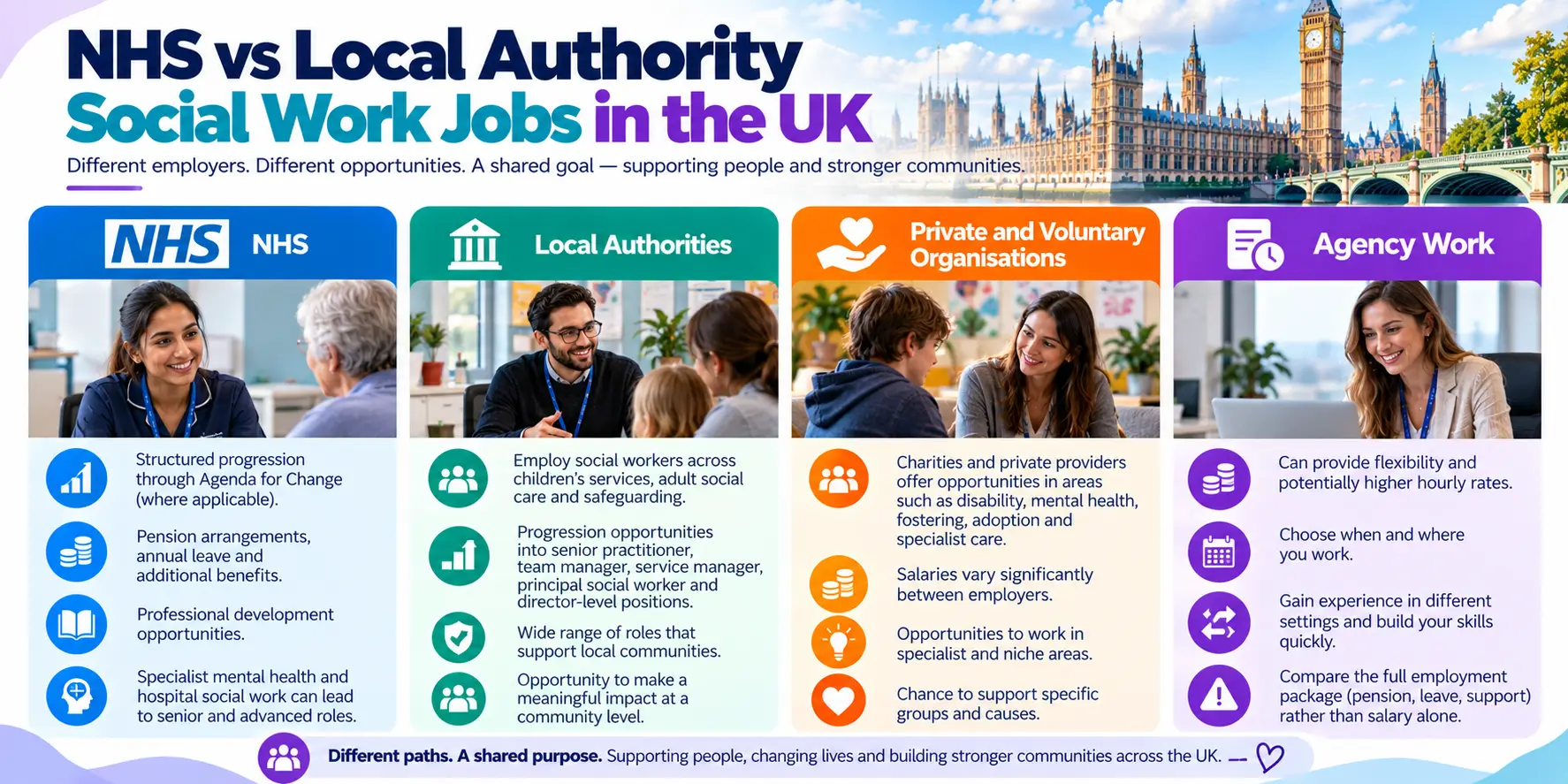
NHS vs Local Authority Social Work Jobs
The NHS and local authorities are two major employers of social workers.
NHS
NHS social work positions can offer structured progression through Agenda for Change where applicable. Employees may also receive benefits such as pension arrangements, annual leave and professional development opportunities.
Specialist mental health and hospital social work can provide routes towards senior and advanced positions.
Local Authorities
Councils employ social workers across children’s services, adult social care and safeguarding. There are progression opportunities into senior practitioner, team manager, service manager, principal social worker and director-level positions.
Private and Voluntary Organisations
Charities and private providers offer opportunities in areas such as disability, mental health, fostering, adoption and specialist care. Salaries vary significantly between employers.
Agency Work
Agency social work can provide flexibility and potentially higher hourly rates, but professionals should compare the full employment package rather than salary alone.
Qualifications Needed to Become a Social Worker
To become a social worker in England, you normally need an approved social work qualification and professional registration with Social Work England. Qualification routes include undergraduate degrees, postgraduate programmes, degree apprenticeships and graduate training routes.
Newly qualified professionals can also complete the Assessed and Supported Year in Employment, or ASYE, which provides structured support during the first year of professional practice.
Registration requirements differ across the UK, so professionals should check the regulator for the country where they intend to practise.
For career progression, continuing professional development is also important. Specialist training can help social workers move into advanced practice, mental health, safeguarding, education or management.
Social Work Career Progression UK
A typical social work career progression UK pathway might look like:
Newly Qualified Social Worker
↓
Experienced Social Worker
↓
Senior Social Worker / Senior Practitioner
↓
Specialist or Advanced Practitioner
↓
Team Manager / Consultant / Principal Social Worker
↓
Service Manager / Head of Service
↓
Assistant Director
↓
Director
This is only one possible route. Social workers do not have to become managers to progress.
A specialist route can include:
Social Worker → Senior Practitioner → Specialist Social Worker → Consultant/Advanced Practitioner
Another option is:
Social Worker → Mental Health Social Worker → AMHP → Senior/Advanced Mental Health Professional
The best route depends on your interests, strengths and preferred working environment.
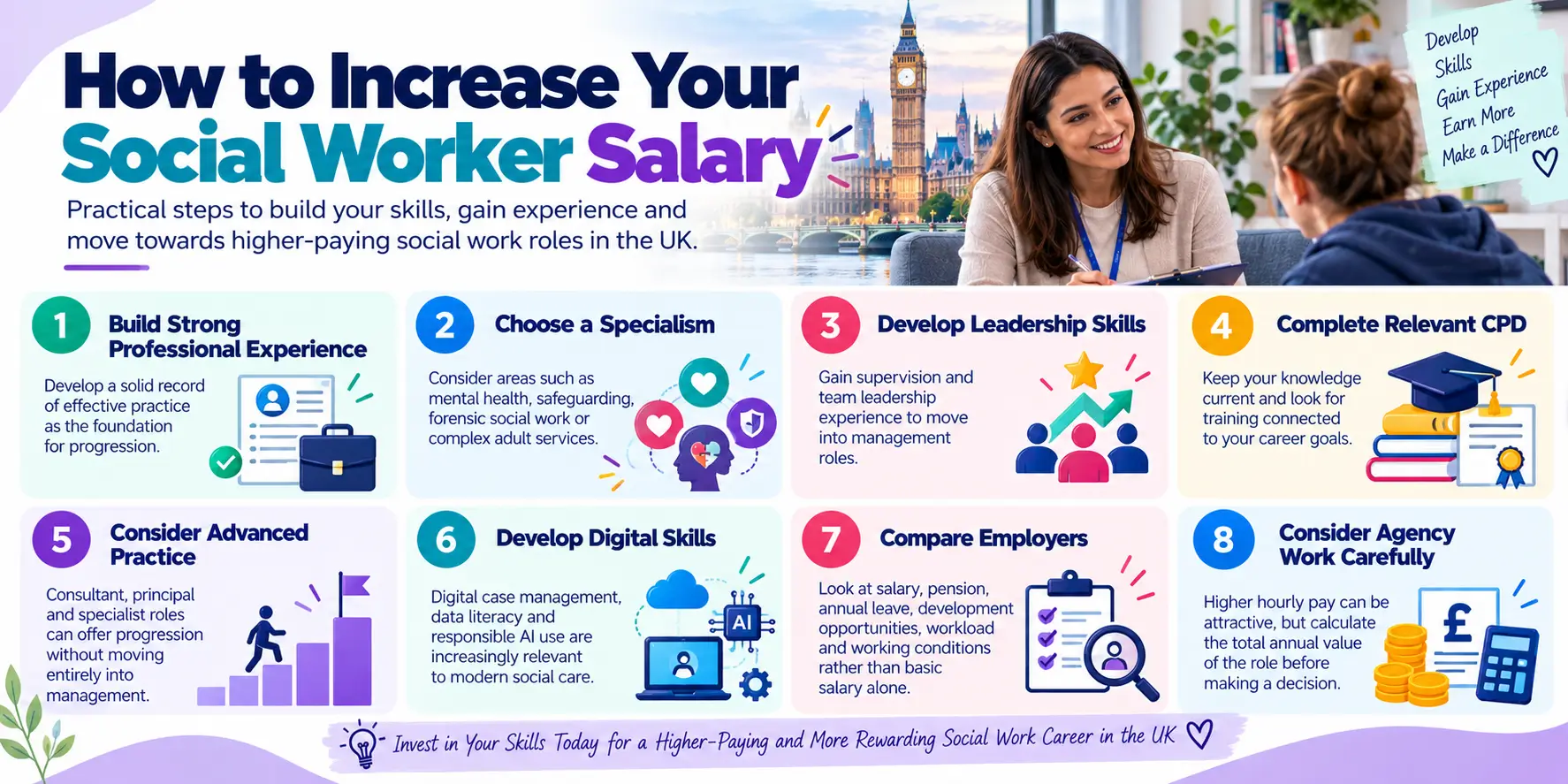
How to Increase Your Social Worker Salary
If you want to progress towards the highest paying social work careers UK, consider these steps:
1. Build strong professional experience
Developing a strong record of effective practice is the foundation for progression.
2. Choose a specialism
Consider areas such as mental health, safeguarding, forensic social work or complex adult services.
3. Develop leadership skills
Supervision and team leadership experience can help you move into management.
4. Complete relevant CPD
Keep your knowledge current and look for training connected to your career goals.
5. Consider advanced practice
Consultant, principal and specialist roles can offer progression without moving entirely into management.
6. Develop digital skills
Digital case management, data literacy and responsible AI use are becoming increasingly relevant to modern social care.
7. Compare employers
Look at salary, pension, annual leave, development opportunities, workload and working conditions rather than basic salary alone.
8. Consider agency work carefully
Higher hourly pay can be attractive, but calculate the total annual value of the role before making a decision.
Social Work Skills for 2027
The future of social work will require a combination of human and digital skills.
Important digital skills in social care may include:
- Digital case-management systems
- Data interpretation
- Information security
- Digital safeguarding
- AI awareness
- Data privacy
- Responsible technology use
Skills England’s recent health and adult social care assessment identifies digital, data and technology skills as an area requiring further development across adult social care.
However, technology does not replace the human side of social work. Communication, empathy, active listening, professional judgement, safeguarding and advocacy remain essential.
Is Social Work a Good Career in the UK?
Social work can be an excellent career if you want meaningful work and enjoy helping people solve complex problems.
Benefits
- Meaningful and people-focused work
- Multiple specialisms
- Career progression
- Opportunities across the UK
- Public, private and voluntary-sector opportunities
- Leadership and advanced-practice pathways
- Transferable professional skills
Challenges
- Emotionally demanding work
- Complex cases
- Heavy administrative responsibilities
- Safeguarding pressure
- Ongoing professional development
- Salary differences between employers
The profession should therefore be considered as a complete career, rather than simply a route to a high salary.
Conclusion
The highest paying social work jobs UK are generally found at senior management, executive and specialist levels. Directors, heads of social work, assistant directors, service managers and advanced practitioners can earn substantially more than newly qualified professionals.
However, salary should not be the only factor when choosing a social work career. Your interests, preferred client group, work environment, professional development opportunities and work-life balance are equally important.
If you are beginning your career, focus first on gaining strong experience and developing your professional skills. Over time, you can specialise, move into advanced practice, become a consultant or principal social worker, take on management responsibilities or progress towards senior leadership.
For professionals planning their social work career progression UK, the most valuable investment is continuous learning. Specialist knowledge, leadership ability, digital skills and strong professional judgement can all help you move towards more advanced opportunities.
FAQ
Director and senior executive social care positions can offer some of the highest salaries, with certain roles exceeding £100,000. These positions require extensive professional and management experience.
The National Careers Service currently gives a guide of around £32,000 for starters and £48,000 for experienced social workers. Actual salaries vary by employer, location, specialism and experience.
There is no single highest-paying specialism across the whole UK. Senior leadership, management and advanced specialist roles generally provide the greatest earning potential.
Yes. Experienced social workers can reach £50,000 or more in senior, specialist, management and certain NHS positions.
Not necessarily. Approved undergraduate and postgraduate routes are available. The important requirement is completing an approved qualification and registering with the relevant UK regulator.
Some agency assignments offer higher hourly rates, but you should compare pension, holiday pay, job security, travel and other benefits before deciding.
Mental health, safeguarding, children’s services, adult social care, forensic services and other specialist areas can offer opportunities. Demand varies by employer and region.
Gain experience, develop specialist knowledge, complete relevant CPD, build leadership skills and apply for senior, specialist or management positions as your experience grows.
AI is more likely to change how some administrative and information-based tasks are performed than replace the human role of a social worker. Professional judgement, empathy, safeguarding and human relationships remain central to social work.
Yes, particularly for people who want meaningful work and multiple career pathways. The profession can lead to specialist, advanced-practice, management and executive positions across the UK.
Salary disclaimer: Salary figures in this article are indicative guides, not guaranteed 2027 salaries. Actual pay varies by employer, location, experience, qualifications, specialism, responsibilities and employment type. Always check current vacancies and official employer salary information before applying.