

Cyber security is a core concern for banks, retailers, manufacturers, public bodies and critical infrastructure. The best-paid roles combine technical expertise with risk or leadership.
So, what are the highest paying cyber security jobs UK employers are likely to value in 2027? Pay depends on experience, location, sector, clearance and responsibility. A graduate should not expect a six-figure package simply because a role has “cyber” in its title.
The 2026 UK Government research estimates 145,900 cyber workers and 7% growth in average core postings during 2025.
For anyone considering cyber security careers UK-wide, this creates opportunities, but it also makes specialisation increasingly important. Cloud security, application security, identity, incident response, AI security and security engineering are all areas worth exploring.
What are the highest-paying cyber security jobs in the UK in 2027?
The strongest earning potential is generally found in executive, architecture, management and specialist engineering roles. CISO, Head of Security, Security Architect, Security Operations Manager, Cloud Security Engineer, Application Security Engineer and senior security engineering positions can all command strong pay. The figures below are benchmarks, not guaranteed 2027 earnings.
Cyber Security Salary in the UK: What Can Professionals Expect?
There is no single cyber security salary UK figure. The Government’s 2025 report recorded a £55,000 median advertised salary for core cyber roles. The 2026 report puts the workforce at about 145,900, with core postings up 7% from 2024.
Junior roles commonly sit below the national median; specialist and senior roles can earn substantially more.
Location matters, with London often paying more for senior security leadership. Robert Half puts the 2026 national CISO range at £96,250–£161,750 and London at £131,000–£220,000.
Salary figures are indicative and vary by experience, location, employer, specialisation, clearance, bonuses and benefits.
15 Highest-Paying Cyber Security Jobs in the UK
1. Chief Information Security Officer (CISO)
Indicative salary: £96,000–£162,000 nationally; London can exceed £220,000 at the upper end.
A CISO owns security strategy and connects cyber risk with business decisions. The role covers security policies, risk management, budgets, teams, incident leadership and executive reporting. Strong candidates combine technical understanding with leadership, communication and commercial judgement. Reaching this level normally requires substantial experience.
Robert Half’s 2026 benchmark supports the national range, while its London benchmark shows significantly higher earning potential.
2. Head of Cyber Security
Indicative salary: about £77,000–£105,000 nationally; London benchmarks can reach about £143,000.
A Head of Security turns strategy into operational delivery. It may cover operations, risk, assurance, incident response and team leadership. The role suits experienced professionals who can manage people and priorities as well as technology.
Robert Half lists £77,000–£105,000 nationally and £104,750–£142,750 in London.
3. Cyber Security Director
Indicative salary: roughly £90,000–£160,000+, depending heavily on organisation and scope.
A Cyber Security Director sets security strategy across teams or regions, covering governance, investment, compliance, resilience and executive stakeholder management. Public datasets often group director roles with wider security leadership positions, so the range is indicative.
Glassdoor’s UK data shows an average base salary of about £104,000, with additional pay averaging around £21,000. Recent reported London salaries also demonstrate that senior directors can exceed £140,000 in total pay.
4. Security Architect
Indicative salary: about £69,500–£89,500 nationally, with higher packages possible for senior or London roles.
Security Architects design security into networks, applications, cloud platforms and enterprise environments. They assess threats, define controls and make sure architecture supports business requirements.
Cloud security, zero trust architecture, IAM and secure design are increasingly useful. Robert Half’s 2026 national benchmark is £69,500–£89,500.
5. Security Operations Manager
Indicative salary: about £67,500–£97,500, with a current median around £85,000.
This role leads threat detection and response, often overseeing a SOC, SIEM, incident response and automation. IT Jobs Watch recorded an £85,000 UK median and £97,500 90th percentile.
It is particularly suitable for professionals progressing from SOC analyst, incident response or security engineering positions into management.
6. Cloud Security Engineer
Indicative salary: around £58,750–£87,500 in current UK vacancy data, with senior specialists potentially higher.
Cloud Security Engineers protect AWS, Azure and Google Cloud environments through identity controls, segmentation, workload protection, logging and incident response.
Cloud security is increasingly relevant as organisations depend on cloud and hybrid infrastructure. IT Jobs Watch recorded a £75,000 median for Cloud Security Engineer vacancies in the six months to October 2026.
7. Application Security Engineer
Indicative salary: about £58,750–£100,000 based on recent UK vacancy benchmarks.
Application Security, or AppSec, brings security into software development through threat modelling, code reviews, security testing, vulnerability management and secure CI/CD pipelines.
Knowledge of APIs, cloud security and DevSecOps is valuable. IT Jobs Watch recorded a £75,500 median and £100,000 75th percentile for UK vacancies citing application security.
8. Senior Security Engineer
Indicative salary: roughly £65,000–£90,000+, depending on specialism and seniority.
Security Engineers implement controls across networks, endpoints, cloud environments and security platforms. At senior level, they may design solutions and automate repetitive work.
Robert Half benchmarks Security Network Engineers at £50,750–£72,250 nationally. Information Security Engineer data shows a higher median, although the current sample is very small.
9. Cyber Security Consultant
Indicative salary: approximately £37,000–£64,000 base pay, with senior and specialist roles potentially higher.
Consultants advise on security strategy, architecture, assessments, compliance, risk and technical controls across multiple clients.
Glassdoor’s current UK data shows an average base pay of about £49,000, with a base range of approximately £37,000–£64,000. Individual employers and seniority can push compensation higher.
Communication, risk analysis, security frameworks and presentation skills are important alongside technical knowledge.
10. Penetration Tester / Ethical Hacker
Indicative salary: about £45,000–£89,250 in recent vacancy data.
Penetration Testers legally simulate attacks to identify weaknesses before criminals exploit them. The work can cover applications, infrastructure, APIs and cloud.
IT Jobs Watch recorded a £65,000 UK median and £89,250 90th percentile in the six months to October 2026.
Practical labs, strong reporting skills and recognised testing qualifications can help candidates progress.
11. Identity and Access Management Specialist
Indicative salary: about £46,000–£88,000, with the current median around £75,000.
IAM specialists control who can access systems, what they can access and under which conditions. Their work connects with zero trust, privileged access, single sign-on and cloud identity.
IT Jobs Watch recorded 963 permanent UK vacancies citing IAM and a £75,000 median over the six months to October 2026.
IAM is a useful specialisation for professionals interested in both technical security and business controls.
12. Incident Response Specialist
Indicative salary: about £50,000–£90,000 as an indicative specialist range.
Incident responders investigate events, contain attacks, preserve evidence and support recovery. IT Jobs Watch found 1,318 UK permanent vacancies citing Incident Response and a £70,000 median for those vacancies in the six months to October 2026.
The role rewards calm decision-making, technical investigation and practical experience because real incidents rarely follow a textbook.
13. Threat Intelligence Analyst
Indicative salary: about £43,625–£88,000 based on current vacancy benchmarks.
Threat Intelligence Analysts turn information about threat actors, campaigns and vulnerabilities into useful intelligence. They may track malware, ransomware groups and indicators of compromise.
IT Jobs Watch recorded a £70,000 median and £88,000 75th percentile for UK vacancies citing threat intelligence through September 2026.
Analytical writing and the ability to explain intelligence to decision-makers are as important as technical knowledge.
14. Digital Forensics Analyst
Indicative salary: about £38,500–£95,000 in current vacancy data.
Digital Forensics Analysts examine devices, systems and digital evidence after incidents or suspected wrongdoing. The work includes evidence preservation, timeline analysis, malware investigation and reporting.
IT Jobs Watch recorded a £50,000 median and £95,000 90th percentile.
15. Cyber Security Analyst
Indicative salary: roughly £42,250–£56,000 for current national starting benchmarks.
Cyber Security Analysts monitor alerts, investigate suspicious activity, maintain security controls and support incident response. It remains an accessible entry point, although junior competition can be significant.
Robert Half’s 2026 benchmark is £42,250–£56,000 nationally. Build skills in networking, SIEM, endpoint security and investigation before moving towards better-paid specialist roles.
AI and Cyber Security: A New Salary Driver?
AI is changing both cyber attacks and defensive work. AI-powered threat detection can help analysts process large volumes of telemetry, while security teams increasingly need people who understand how to secure generative AI applications, models, data and access.
The Government’s 2026 research reports 70% of cyber firms using AI in daily work and 73% expecting greater AI-skill needs over the following 12 months.
This does not mean every AI security jobs role will pay more. The advantage is more likely to come from combining security fundamentals with AI risk, governance, secure AI development, threat detection or automation.
What Skills Do High-Paying Cyber Security Jobs Require?
Well-paid cyber roles generally require depth plus breadth. Technical skills include network security, cloud security, IAM, application security, vulnerability management, architecture, threat intelligence and incident response. Senior professionals also need risk management, governance, communication and leadership.
Security teams cannot manually investigate every alert, so scripting, SOAR workflows and automation can improve efficiency. Cloud-native security and zero trust are also valuable because identity, configuration and workload security increasingly overlap.
At senior level, business understanding matters. Security leaders must explain risk in terms of finance, continuity, regulation and reputation, not only vulnerabilities.
Most In-Demand Cyber Security Skills in the UK
Skill | Example Roles | Why Employers Value It |
Cloud Security | Cloud Security Engineer | Protects cloud infrastructure |
IAM | IAM Specialist | Controls identities and access |
Incident Response | Incident Responder | Limits damage during attacks |
Governance | Security Manager | Supports compliance and risk |
AI Security | AI Security Specialist | Secures AI systems |
Automation | Security Engineer | Improves efficiency |
Risk Management | Cyber Risk Manager | Connects security to business |
Threat Intelligence | Threat Analyst | Helps anticipate threats |
The Government identifies governance, risk, incident response, Azure, automation and AI as important skills.

Cyber Security Certifications That Can Support Career Progression
Certifications can demonstrate structured knowledge, especially when experience is limited, but they do not replace practical work.
Security+ suits many beginners, while CySA+ can support an analyst pathway. CISSP and CISM can support experienced professionals moving towards senior security, governance or management responsibilities. CCSP fits cloud security, while OSCP and CREST qualifications can suit penetration testing.
Cloud professionals can consider AWS, Microsoft Azure or Google Cloud security certifications. ISO/IEC 27001 training can support governance and compliance careers.
Choose qualifications that match your target role.
Can You Get a High-Paying Cyber Security Job Without a Degree?
Yes. Apprenticeships, IT support, networking, certifications, practical labs, internships and portfolio projects can provide alternative routes. Employer requirements differ, and senior positions normally require substantial experience.
Government research shows that degree-level qualifications remain common in advertised core cyber roles, while employers also value tangible experience.
For senior roles, what you have delivered can matter greatly. Incident leadership, secure architecture, cloud projects, risk programmes and measurable security improvements can strengthen your profile.
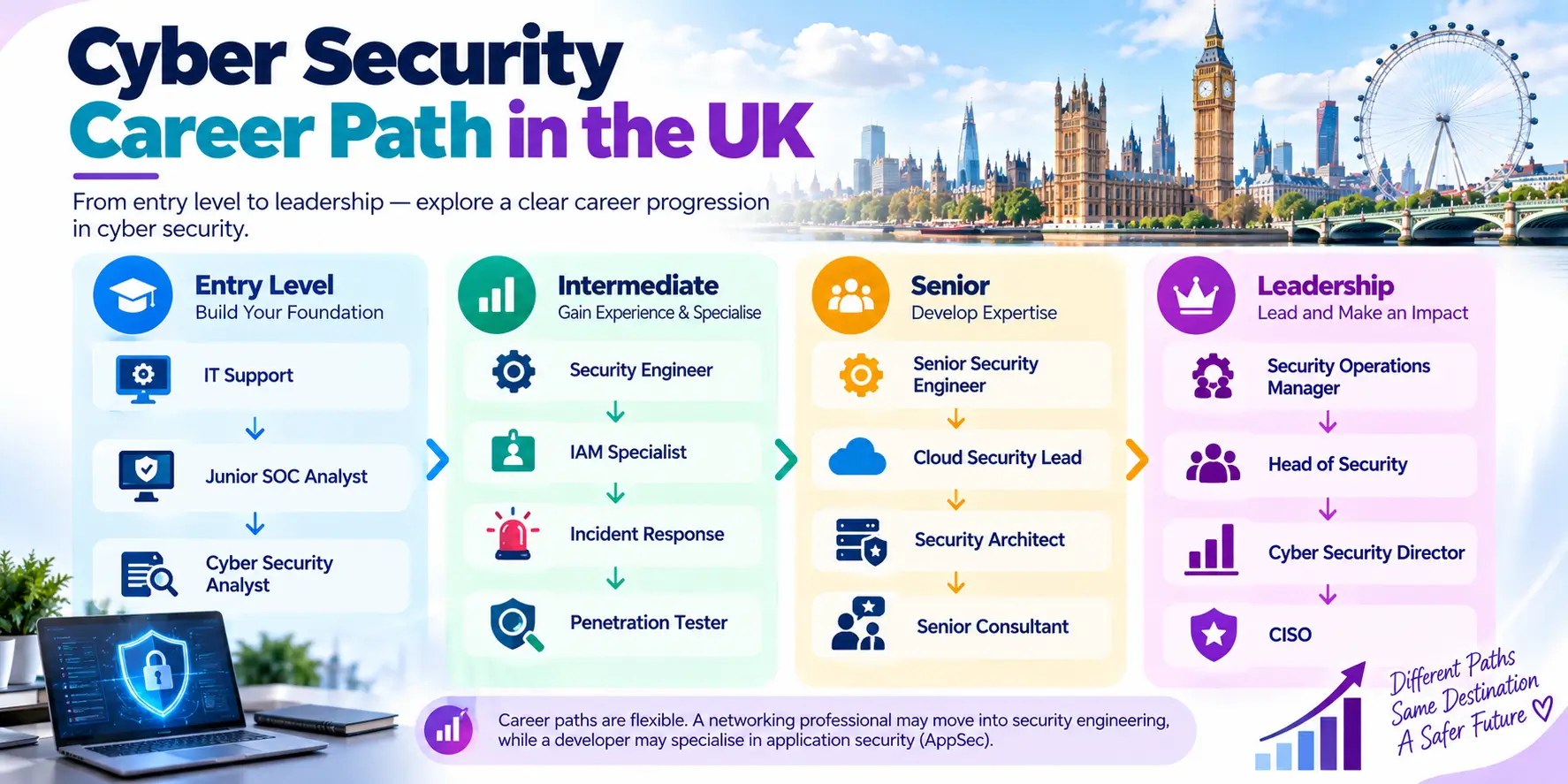
Cyber Security Career Path in the UK
A realistic cyber security career path UK might look like:
Entry level: IT Support → Junior SOC Analyst → Cyber Security Analyst
Intermediate: Security Engineer → IAM Specialist → Incident Response → Penetration Tester
Senior: Senior Security Engineer → Cloud Security Lead → Security Architect → Senior Consultant
Leadership: Security Operations Manager → Head of Security → Cyber Security Director → CISO
Career paths are not fixed. A networking professional may move into security engineering, while a developer may specialise in AppSec.
How to Increase Your Cyber Security Salary
- Build practical experience.
- Choose a valuable specialisation.
- Develop cloud security skills.
- Learn scripting and automation.
- Understand AI security and AI risk.
- Improve communication.
- Gain relevant certifications.
- Build an authorised-lab portfolio.
- Consider regulated industries.
- Develop leadership and risk-management skills.
Compare total compensation, responsibilities and career prospects when considering a move
Is Cyber Security a Good Career in the UK in 2027?
For people who enjoy problem-solving and continuous learning, cyber security can remain a strong career choice. The Government reports 7% growth in average core postings during 2025, while noting slower workforce growth and a challenging early-career market.
That balance matters. Cyber security is not an effortless route to a high salary. Competition can be strong, technologies change quickly and some roles involve on-call work or significant pressure during incidents.
The strongest cyber security careers UK-wide are likely to favour professionals who combine technical ability with practical judgement, communication and business-risk awareness.
Conclusion
The highest paying cyber security jobs UK employers offer are concentrated in leadership, architecture, engineering and specialist areas. CISO and senior security leadership roles sit at the top of the pay scale, while cloud security, application security, IAM, security operations and incident response provide strong specialist pathways.
Do not chase a title purely for its salary. Build foundations, gain experience, specialise, learn cloud and automation, and develop business awareness.
AI security, zero trust, cloud-native security, cyber resilience and security automation are likely to shape cyber security careers UK-wide in 2027. Explore Upskillora’s career guides and learning resources to keep building the knowledge and practical skills needed for your next step.
FAQ
CISO is generally among the highest-paid cyber security positions, particularly in large organisations and London. Robert Half’s 2026 national benchmark is £96,250–£161,750, while its London range reaches £220,000 at the 75th percentile. Bonuses and benefits can sit outside base salary.
There is no single average for every cyber role. The UK Government’s 2025 research, covering 2024, reported a £55,000 median advertised salary for core cyber vacancies. Pay varies by role, experience, location and specialisation, so compare the relevant job family.
Current evidence points to cloud security, IAM, incident response, governance, risk, Azure, automation and AI. Government research also reports 7% growth in average core cyber postings in 2025. Specialist skills can improve employability when combined with practical experience.
Leadership roles such as CISO, Head of Security and Cyber Security Director have the greatest earning potential. Security Architect, Cloud Security Engineer, AppSec Engineer and Security Operations Manager can also pay well. There are no universal confirmed 2027 salaries, so 2026 benchmarks are indicators.
Yes. Apprenticeships, IT support, networking, certifications, practical labs, internships and portfolio projects can provide alternative routes. Employer requirements differ, and senior positions normally require substantial experience. Authorised security projects can demonstrate capability when formal qualifications are limited.
There is no single best certification. Security+ suits many beginners, while CISSP or CISM can support experienced professionals moving into senior roles. CCSP fits cloud security, and OSCP or CREST can suit penetration testing. Choose according to your target job and combine certification with practical experience.
It can suit people who enjoy technology, investigation and continuous learning. Demand exists, but junior competition and changing technology make preparation important. Combining technical skills with cloud, AI, automation, communication and risk awareness can create more progression routes.
Build experience in a valuable specialisation, learn cloud security, automation and AI security, and improve communication and leadership. Relevant certifications can strengthen your profile. Moving into architecture, consulting, management or a scarce technical speciality may increase earning potential, depending on experience and employer.