
Artificial intelligence is changing the way people work across the UK. From generating reports and analysing data to supporting customer service, software development and business decisions, AI is moving from something associated mainly with technology companies to a practical workplace tool.
This makes one question increasingly important for students, graduates, professionals and career changers: what skills will employers want most in 2027?
The answer is not simply “AI”. Employers are likely to value people who can combine AI literacy with professional expertise, digital skills, critical thinking and good judgement. At the same time, specialist careers are developing around artificial intelligence, creating opportunities for people interested in machine learning, software development, data and AI engineering.
The UK government has already identified AI skills as an important workforce priority. Skills England’s 2026 benchmark divides AI foundation skills into technical, non-technical, and responsible or ethical areas, reflecting the fact that AI capability is becoming relevant well beyond specialist technology roles. GOV.UK
So, when thinking about AI and UK jobs in 2027, the goal should not be to predict exactly which occupations will disappear. A more useful question is: which skills will help people work effectively alongside AI?
What AI Skills Will Employers Want Most in 2027?
Employers are likely to value a combination of AI literacy, generative AI skills, data literacy, automation, critical thinking, responsible AI awareness, communication and adaptability. Technical professionals may also need skills such as Python, machine learning, cloud computing and AI application development. For most workers, however, the ability to use AI effectively, verify its output and apply it to real workplace problems may matter more than becoming an AI engineer.
How AI Is Changing the UK Job Market
AI is affecting the UK labour market in several different ways. The change is not limited to creating new AI jobs. It can also alter the tasks people already perform.
Skills England’s 2026 annual skills report notes that AI is likely to automate or augment aspects of many occupations, while the exact impact remains uncertain and uneven across sectors. Its analysis cites research suggesting that around 70% of UK workers are in occupations containing tasks that AI could potentially perform or enhance. GOV.UK
There are four useful ways to understand this change.
Automation
AI can automate repetitive and predictable activities. Examples include processing routine information, producing first drafts, categorising documents, basic data processing and some administrative workflows.
Automation does not necessarily mean an entire job disappears. More often, individual tasks may change.
Augmentation
AI can also make existing employees more productive. A marketer might use AI to generate initial campaign ideas. A developer might use AI-assisted coding tools. An analyst might use AI to explore a large dataset before validating the results.
The employee remains responsible for deciding whether the output is useful and accurate.
Job Redesign
When AI becomes part of a workflow, responsibilities can change. An employee who previously spent several hours creating a report might spend less time preparing the first draft and more time reviewing data, interpreting results and presenting recommendations.
This means some jobs may become less focused on repetitive production and more focused on judgement.
New Opportunities
AI adoption also creates demand for people who can develop, implement, manage and govern AI systems.
This includes areas such as AI engineering, machine learning, AI implementation, AI governance, AI security, data, automation and AI product management.
The UK government is actively supporting AI adoption and skills development. Its AI Opportunities Action Plan identifies AI as an opportunity to increase productivity and create future employment opportunities, while its January 2026 progress report said 38 of the plan’s 50 actions had been met. GOV.UK
The Growing Demand for AI Skills in the UK
AI skills are becoming relevant across industries rather than only in technology companies.
Skills England’s research on AI skills for the UK workforce identifies the need for practical AI capability across sectors and emphasises that most workers will need some level of AI literacy, while a smaller proportion will require specialist technical skills. GOV.UK
This distinction is important.
You do not need to become a machine-learning engineer to benefit from AI. A finance professional, teacher, administrator, engineer, marketer or customer-service specialist can develop AI skills that improve their existing work.
The most valuable combination may therefore be:
Professional expertise + AI literacy + digital fluency + human judgement
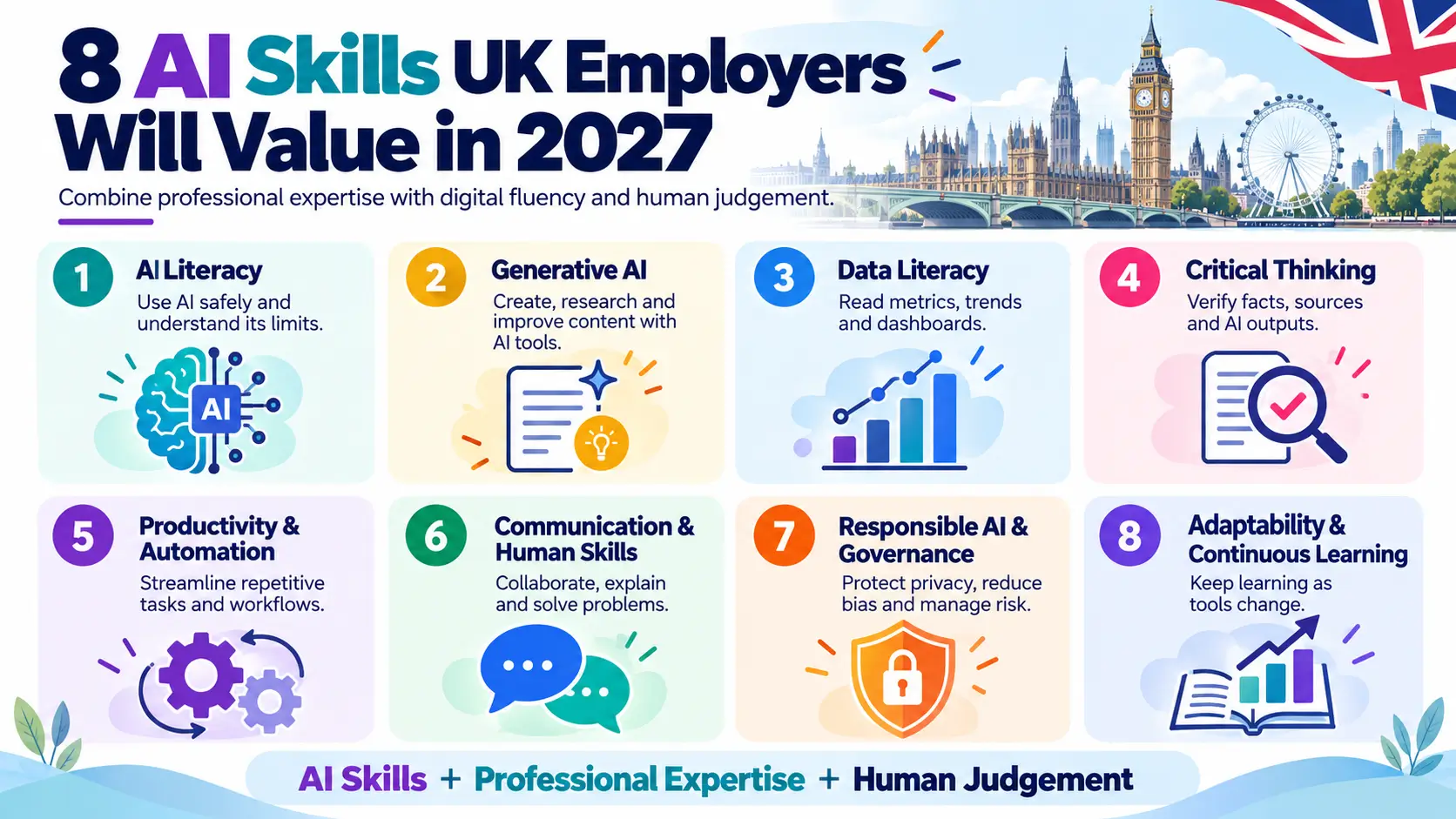
Here are eight AI skills UK employers may increasingly value in 2027.
1. AI Literacy
AI literacy is likely to become a basic workplace capability.
It means understanding what AI tools can do, where they can help, what their limitations are and when human judgement is required.
Someone with strong AI literacy should be able to:
- Write clear instructions for AI tools
- Understand basic AI limitations
- Evaluate AI-generated information
- Identify potentially inaccurate outputs
- Protect confidential information
- Use AI appropriately for workplace tasks
- Understand when human review is necessary
Skills England’s AI foundation skills benchmark specifically includes writing clear instructions for AI tools, using AI to support routine work, understanding risks and analysing information. GOV.UK
In other words, AI literacy skills are becoming less about knowing technical theory and more about using AI safely and effectively.
2. Generative AI and AI Tool Skills
Generative AI is already changing how people create and process information.
Employees may use AI tools for writing, research, brainstorming, summarisation, coding, analysis and workflow support.
However, simply knowing how to open an AI chatbot is not a meaningful professional skill.
Generative AI skills involve knowing how to turn a workplace problem into a useful AI-assisted workflow.
For example, instead of asking an AI tool to “write a report”, a skilled user might provide relevant context, define the intended audience, request a particular structure, review the output against reliable sources and edit the final version.
The difference is between using AI and using AI well.
3. Data Literacy
AI and data are closely connected, making data literacy another important career skill.
You do not necessarily need to become a data scientist. But you should understand basic concepts such as:
- Data quality
- Metrics
- Trends
- Dashboards
- Data interpretation
- Evidence-based decision-making
- AI-generated analysis
AI can produce a convincing answer from poor-quality information. If you cannot recognise unreliable data, you may make a poor decision more quickly rather than a good decision more efficiently.
Data literacy therefore complements AI literacy.
4. Critical Thinking and AI Verification
One of the biggest mistakes employees can make is treating AI output as automatically correct.
AI systems can produce incorrect information, misleading conclusions, outdated information or fabricated references. They can also reflect biases present in their training data or the way a problem is presented.
That makes critical thinking increasingly valuable.
Workers should know how to:
- Check important claims
- Compare information with reliable sources
- Question unexpected results
- Identify potential bias
- Review calculations
- Check citations
- Recognise when an AI answer is uncertain
- Apply professional judgement
This may become especially important in healthcare, finance, engineering, legal services, cybersecurity and other areas where mistakes can have serious consequences.
5. AI Productivity and Automation
AI productivity is about using technology to improve the way work gets done.
Employees can potentially use AI to:
- Summarise long documents
- Draft routine communications
- Organise information
- Analyse data
- Support research
- Generate ideas
- Automate repetitive processes
- Create workflow templates
The important skill is not automating everything.
Instead, professionals should identify tasks where AI can save time without reducing quality, privacy or accountability.
Skills England’s 2026 research highlights the importance of workforce capability keeping pace with AI adoption and warns that simply providing access to AI tools does not guarantee that employees have the confidence or judgement to use them effectively. skillsengland.blog.gov.uk
6. Communication and Human Skills
AI does not make communication, collaboration or leadership irrelevant.
In some situations, these skills may become even more important.
When AI handles more routine information work, people can spend more time on activities requiring:
- Communication
- Collaboration
- Leadership
- Creativity
- Empathy
- Negotiation
- Problem-solving
- Relationship management
An employee who can use AI but cannot explain a recommendation to a client may be less effective than someone who can combine technology with strong communication.
The future is therefore unlikely to be simply AI skills vs human skills.
It is more accurately:
AI skills + professional expertise + human judgement.
7. Responsible AI, Governance and Risk
As organisations use AI more extensively, responsible use becomes increasingly important.
Employees and specialists may need to understand:
- AI governance
- Data privacy
- Cybersecurity
- Bias
- Accountability
- AI ethics
- Human oversight
- AI risk management
This is particularly relevant for organisations handling sensitive personal, financial or business information.
The UK’s AI skills framework explicitly recognises responsible and ethical AI skills as part of workforce preparation. GOV.UK
This could create opportunities beyond technical development, including AI governance, compliance, risk management and policy-related careers.
8. Adaptability and Continuous Learning
Perhaps the most transferable skill in the AI era is the ability to learn.
AI tools, software platforms and workplace processes can change quickly. A tool learned today may work differently in a year.
That makes AI upskilling and AI reskilling ongoing activities rather than one-time achievements.
Workers who regularly develop their skills can respond more effectively when their responsibilities change.
The UK government’s current AI skills initiatives reflect this need. In 2026, Skills England announced an AI Skills Boost programme intended to support practical AI capability and an ambition to upskill 10 million people by 2030. GOV.UK
AI Engineer Jobs UK: Why AI Engineering Is Becoming an Important Career Path
For people who want a more technical career, AI engineer jobs UK are an area worth exploring.
An AI engineer generally works on developing and integrating AI-powered applications and systems. Depending on the employer, the role can combine software engineering, machine learning, data processing and modern generative AI technologies.
Typical responsibilities can include:
- Developing AI applications
- Working with machine-learning models
- Integrating AI APIs
- Building AI-powered systems
- Processing data
- Evaluating model performance
- Testing applications
- Deploying AI systems
- Monitoring systems
- Working with product and engineering teams
The exact role varies considerably between employers.
An AI engineer is not necessarily the same as a machine-learning engineer or data scientist.
Career | Main Focus | Typical Skills | Suitable For |
AI Engineer | Building AI applications | Python, ML, APIs | Technical problem-solvers |
Machine Learning Engineer | ML systems | ML, Python, MLOps | Technical candidates |
Data Scientist | Data and modelling | Statistics, Python, SQL | Analytical candidates |
AI Product Manager | AI products | Product + AI knowledge | Business/technical professionals |
AI Consultant | AI adoption | Strategy + AI | Business professionals |
AI Governance Specialist | AI risk and compliance | Governance, ethics, policy | Risk/compliance professionals |
The UK’s digital and technology skills assessment also identifies an evolving demand for technical expertise alongside skills such as adaptability, accountability, collaboration and communication. GOV.UK
Skills Needed for AI Engineer Jobs
People searching for AI engineer jobs should consider building a combination of technical and practical skills.
Important areas may include:
- Python
- Machine learning
- Deep learning
- Data structures and algorithms
- SQL
- APIs
- Cloud platforms
- Git
- Model evaluation
- MLOps
- Generative AI
- Large language models
- Prompt design
- AI application development
You do not necessarily need every skill listed in every job advertisement.
Requirements vary according to the role. A startup building an AI application may prioritise software development and APIs, while another employer may place greater emphasis on machine learning, cloud infrastructure or MLOps.
How to Get AI Engineer Jobs in the UK
If you want to pursue an AI engineering career, build your skills progressively.
Step 1: Build Programming Fundamentals
Python is widely used in AI and machine learning, so it is a sensible starting point.
Learn variables, functions, data structures, object-oriented programming, error handling and working with libraries.
Step 2: Learn Machine-Learning Fundamentals
Understand the basic concepts behind supervised and unsupervised learning, model training, evaluation and overfitting.
You do not need to master every mathematical detail immediately.
Step 3: Learn Modern Generative AI
Explore large language models, APIs, retrieval-augmented generation and AI application development.
Learn how to evaluate whether an AI application actually works rather than simply demonstrating that it produces output.
Step 4: Build Projects
Projects are one of the best ways to demonstrate practical ability.
Potential portfolio projects include:
- An AI chatbot
- Document question-answering system
- AI recommendation application
- Data-analysis assistant
- CV analysis application
Step 5: Build a GitHub Portfolio
Your GitHub profile should demonstrate what you can build.
Include clear README files, explain the problem your project solves and describe the technologies used.
Step 6: Apply for Internships and Graduate Roles
Look for internships, apprenticeships and graduate AI engineer jobs UK opportunities.
For people at the beginning of their careers, entry level AI engineer jobs UK may have different requirements from experienced positions, so read job descriptions carefully.
Step 7: Demonstrate Business Value
Employers are not only interested in whether you can build a model.
They also want to understand what the technology achieves.
A strong candidate can explain how an AI application saves time, improves accuracy, supports customers, reduces manual work or helps an organisation make better decisions.
In many regions, multidisciplinary assessment teams are involved to ensure comprehensive evaluations.
AI Engineer Jobs UK: Do You Need a Degree?
There is no single answer.
Relevant degrees can include computer science, software engineering, mathematics, data science, engineering and physics.
A technical degree can provide useful foundations in programming, mathematics, algorithms and problem-solving.
However, alternative routes also exist. These can include:
- Bootcamps
- Online learning
- Professional certificates
- Portfolio projects
- Apprenticeships
- Self-directed learning
A degree should not be presented as either universally required or completely unnecessary. Employer expectations vary significantly between positions.
For someone without a computer science degree, a strong portfolio demonstrating programming, AI application development and practical problem-solving can help demonstrate capability.
AI Skills vs Human Skills
Traditional Skill | AI-Era Skill | Why It Matters |
Research | AI-assisted research + verification | Faster but accurate information gathering |
Writing | AI-assisted writing + editing | Higher productivity |
Data analysis | AI-assisted analysis + data literacy | Faster insights with human validation |
Administration | Workflow automation | Reduced repetitive work |
Problem-solving | Human-AI problem-solving | Better decision support |
Communication | Human communication + AI support | Better collaboration |
The strongest professionals may not be those who know the most AI terminology.
They may be those who understand how to combine AI with their existing professional knowledge.
Which UK Jobs Are Most Affected by AI?
Occupations involving repetitive, predictable or information-heavy tasks may experience significant changes.
Examples include:
- Administrative work
- Data-entry activities
- Customer support
- Routine content production
- Basic research
- Some forms of analysis
- Certain junior software-development tasks
- Back-office functions
However, it is important to distinguish between tasks and occupations.
AI may automate a task without eliminating the entire job.
Skills England’s 2026 assessment emphasises that AI’s impact is uneven across occupations and that it remains difficult to separate AI’s effects from broader labour-market changes. GOV.UK
Which UK Jobs Could Grow Alongside AI?
Potential areas of opportunity include:
- AI engineering
- Machine learning
- AI implementation
- AI governance
- AI compliance
- AI security
- Data
- Automation
- Digital transformation
- AI product management
- AI consulting
- AI training
- AI risk management
The UK’s AI ecosystem is also developing outside London and the South-East. Skills England’s 2026 report notes that several UK regions, including the West Midlands, North-West, East Midlands, Wales, and Yorkshire and the Humber, have more than doubled their number of AI firms since 2022. GOV.UK
That suggests people interested in AI careers UK should look beyond a single city or technology hub.
AI and Graduate Jobs in the UK
Graduate recruitment deserves particular attention.
Some entry-level work consists of repetitive information-processing tasks that AI can increasingly support. This may change the types of responsibilities given to junior employees.
But current evidence does not justify claiming that AI is solely responsible for changes in graduate employment.
Skills England’s 2026 report highlights evidence of weaker junior recruitment in some AI-exposed firms, while also noting that other research finds it difficult to establish whether AI is responsible because economic conditions and post-pandemic labour-market changes also play a role. GOV.UK
For graduates, the practical response is to become difficult to substitute and easy to train.
Develop:
- AI literacy
- Communication
- Technical literacy
- Industry knowledge
- Portfolio projects
- Data skills
- Critical thinking
- Practical AI experience
These can make a graduate more useful from day one.
AI Skills to Put on Your CV in 2027
Simply writing “AI skills” on your CV is unlikely to say much.
Instead, explain what you actually did.
Weak:
Knowledge of AI.
Better:
Used generative AI tools to support research, content development and workflow automation, with human review for accuracy.
Other examples could include:
Marketing:
Used generative AI to support campaign research, content ideation and audience analysis.
Administration:
Applied AI tools to summarise documents and streamline repetitive information-processing tasks.
Engineering:
Used AI-assisted tools to support technical research and documentation while independently validating outputs.
IT:
Used AI-assisted coding and troubleshooting tools to improve development workflows and documentation.
Finance:
Used AI-assisted analysis for initial data exploration, followed by manual verification of results.
AI engineering:
Developed and evaluated an AI application using Python, APIs and a large language model.
This is what makes AI skills on CV statements meaningful: they demonstrate application rather than buzzwords.
How to Become AI-Ready Without Becoming an AI Engineer
Most workers do not need to become AI engineers.
Instead, focus on becoming AI-enabled within your own profession.
A practical roadmap is:
- Learn AI fundamentals.
- Learn generative AI tools.
- Apply AI to your existing profession.
- Develop data literacy.
- Learn verification and critical thinking.
- Understand responsible AI.
- Build practical projects.
- Continue learning.
For example, a digital marketer could learn AI-assisted research and campaign analysis.
An engineer could use AI for documentation, data analysis and coding support.
A teacher could explore AI-assisted lesson planning while learning how to check generated information.
The goal is to connect AI skills with existing expertise.
2027 AI Workplace Trends to Watch
Several developments are worth watching as we move towards 2027.
Generative AI at Work
Generative AI is likely to continue moving into everyday workplace processes.
AI Agents and Agentic AI
AI agents may increasingly perform sequences of tasks rather than simply responding to individual prompts. The practical workplace impact will depend on reliability, security and organisational adoption.
AI-Assisted Coding
Software developers are increasingly working with AI-enabled development tools. This may shift some emphasis from writing every line manually towards reviewing, testing and directing generated code.
AI Governance
As AI becomes more widely deployed, organisations will need stronger processes around privacy, security, accountability and risk.
Human-AI Collaboration
Workers may increasingly be expected to supervise, validate and improve AI-supported processes.
Hybrid AI Roles
People combining AI knowledge with another domain, such as finance, healthcare, engineering, marketing or cybersecurity, may have an advantage in roles where industry context matters.
These trends should be treated as developments to monitor rather than guaranteed predictions.
How to Future-Proof Your Career in the UK
There is no career that can be made completely future-proof.
However, you can make your career more adaptable.
Use this framework:
Professional expertise + AI literacy + digital fluency + human skills + continuous learning
Over the next 30 days, you could:
Week 1: Learn the fundamentals of AI and generative AI.
Week 2: Identify three repetitive tasks in your current profession that AI could potentially support.
Week 3: Build one practical AI-assisted project.
Week 4: Add your new skills and measurable results to your CV and LinkedIn profile.
The objective is not to collect dozens of AI certificates.
It is to demonstrate that you can use technology to solve real problems.
Will AI Replace Jobs in the UK in 2027?
AI will almost certainly change many jobs, but predicting exactly how many jobs will disappear is much more difficult.
The more useful distinction is between:
- Automation: AI performs certain tasks.
- Augmentation: AI helps a person perform a task.
- Job redesign: responsibilities change because AI becomes part of the workflow.
- New opportunities: new products, services and specialist roles emerge.
The UK’s AI labour-market research reflects this uncertainty. Current evidence suggests AI exposure is substantial, but its precise effect on employment varies significantly between occupations and sectors. GOV.UK
So instead of asking only, “Will AI replace my job?”, ask:
“Which parts of my job can AI perform, which parts can it improve, and which responsibilities require human expertise?”
That question gives you something practical to act on.
Conclusion
The future of AI and UK jobs in 2027 is unlikely to be about choosing between humans and machines.
It will increasingly be about how effectively people work with AI.
For most professionals, the most valuable starting point is AI literacy. From there, develop generative AI skills, data literacy, critical thinking, automation awareness, responsible AI knowledge and strong human skills.
For technically minded people, opportunities may extend into AI engineer jobs UK, machine learning, software engineering, data science, MLOps and AI application development.
But you do not need to become an AI engineer to prepare for the future.
The strongest career strategy is to combine your existing expertise with AI capability and keep learning as technology changes.
If you are a student, graduate, job seeker or experienced professional, start with the AI skills most relevant to your current career. Build practical experience, demonstrate measurable results and keep your skills moving forward.
Explore more career guides, learning resources and professional-development content on Upskillora to continue building your career for the changing UK job market.
FAQ-AI and UK Jobs in 2027: The Skills Employers Will Want Most
Employers are likely to value AI literacy, generative AI skills, data literacy, critical thinking, automation, responsible AI awareness and adaptability. Technical roles may additionally require Python, machine learning, cloud platforms, APIs and AI application development.
There is no single “best” AI engineering job. Options include AI application engineer, machine-learning engineer, generative AI engineer and AI software engineer. The right role depends on your programming, mathematics, machine-learning and software-development skills.
Search UK job boards, company career pages and professional networks using terms such as “AI Engineer”, “Machine Learning Engineer”, “Generative AI Engineer” and “AI Software Engineer”. Build relevant projects and tailor your CV to each job description.
Common requirements include Python, machine learning, data structures, algorithms, APIs, SQL, Git, cloud technologies and model evaluation. Some positions also require deep learning, MLOps, LLMs or generative AI application development.
A degree can be useful and is required by some employers, particularly for specialised technical positions. Relevant subjects include computer science, engineering, mathematics and data science. Other routes include apprenticeships, professional training and strong technical portfolios.
Graduates can explore AI engineering, data analysis, machine learning, software development, AI implementation, AI consulting and AI governance. The appropriate path depends on their education, technical ability and professional interests.
Jobs containing repetitive or information-heavy tasks may be significantly affected. Administrative work, data processing, routine research, customer support and some coding activities may increasingly involve AI. However, AI exposure does not automatically mean an entire occupation will disappear.
Yes. AI literacy helps employees understand how to use AI tools effectively, evaluate their outputs and recognise risks. Skills England has identified practical AI foundation skills as relevant to workers using simple AI tools at work. GOV.UK
Start with AI fundamentals and generative AI tools. Then apply them to your existing profession. Practise data literacy, verification and responsible AI use, and build small projects that demonstrate practical results.
AI is likely to automate some tasks and change many workflows, but the scale of job displacement remains uncertain. Some work may be augmented or redesigned while new roles emerge. Workers can prepare by developing AI skills alongside professional expertise and human capabilities.